Tuesday, March 07, 2006

NFL Players Lose Millions

A man named Kirk Wright and his company, International Management Associates, were sued in federal and state courts and neither Wright or the money has surfaced. Listed as plaintiffs in the state lawsuit are Terrell Davis, Steve Atwater, Rod Smith, Ray Crockett, Blaine Bishop, Al Smith, all current or former members of the Denver Broncos. Wright and his company are accused of collecting between $115 million and $185 million from at least 500 investors since 1997. Apparantly Wright has ran away with all of these professional athletes money. By tellings these people that he was making accounts and some of the time not even making them at all and pocketing the money, this is a huge issue. As if pro athletes don't complain enough already as it is, this gives them something more to complain about. This is also a court case that is taking away from the government's time. This is not good for the economy at all because now people are going to be afraid to invest their money because of the threat that it could be taken.

Should Your Boss be Blogging?

This article poses an interesting question: Should blogs be allowed in the corporate world? After reading the article, I have come to agree with its ideas. Blogs would be a great way to receive a tremendous amount of feedback from customers without much cost. A blog can allow the tracking of who read and posted information. Also, ranges of options allow adjustment so a blog isn't too open, risking the privacy of a company. In this article, blogging is presented as another technology that makes communication within a business easier and more accessible.

GM want slashes retirement packages

GM want slashes retirement packages
General Motors said Tuesday it would reduce traditional pension benefits for veteran salaried employees and shift newer staff to a defined contribution plan as part of a move to cut high labor costs.
GM's pension liability at the end of 2005 was $10.9 billion, according to its balance sheet.
GM shares lost more than 50 percent of their value in 2005.
Why GM made this decision?
GM's pension liability at the end of 2005 was $10.9 billion, that's really is a large number, after taht it will cut its yearend 2006 pension liability by about $1.6billion and resuit in a pretax charge of about $120 million.

Demand for High Paying Jobs After Lay offs

Over the past year or so many plants in Parkersburg, WV have been closing leading to many lay offs. Many of these workers came right out of high school to work, skipping totally their college education. Most of the workers were making wages well above minimum wage. All these workers have ever known was the jobs they have been working and recieved many payment increases as their time with the companies went on. Now that they've been laid off the only jobs they can seem to find are jobs that only pay between $7-10 an hour. Many of these people have been passing on these "low paying" jobs because of the prices of gas, or because the position wasn't quite right for them. With all of these lay offs over the years the competition to find the good paying jobs has increased greatly. One man said that there may be 20 jobs that are available in the area and 500 people who could be completely qualified to do the job.

Granted some people are taking the low paying jobs because they need the job, and some other assistance is being offered to these people. Some are going to college to take courses that could prepare them for the higher paying jobs, while recieving assistance.

The choice of what one should do is hard. It's the typical supply and demand situation. There is a shortage of the "good paying" jobs. What would anyone in this situation do?

When sleep is just a dream

The greater the competition, the more pressure there is on companies to be productive and efficient. But what does this mean for an individual employee? According to an article entitled “When Sleep is Just a Dream”, it means higher stress levels and less sleep.
On average people should get 6 - 8 hours of sleep a night. But a poll conducted by NBC reveals that about 50% of Americans don't think they get enough sleep while 25% are getting less than 6 hours of sleep per night. This is a 20 year trend of Americans getting less sleep.
Although a lack of sleep is not good for people in general, there are some industries cashing in on people's demanding life styles. 42 million prescriptions for sleeping pills were filled last year; a 60% increase since 2000. The International Sleep Products Association reports that the sale of mattresses priced over $1000 was up by 9% in 2004 as compared to 2000. Not to mention all of the coffee shops popping up everywhere to provide people with a quick jolt of energy.
Despite these few industries that are benefiting from a society deprived of sleep, what is this lack of sleep doing to the rest of the economy? By working longer hours are people really being more productive or are they just taking longer to do the same job because they are tired? The article suggests that a simple answer to this problem would be a 20 minute nap in the middle of the day. Do you see companies making napping part of their corporate culture? If not, what will be the long-term consequences of this lack of sleep? Or won't there be any?

Mardi Gras to fatten New Orleans tourism

The time for Mardi Gras comes every year and it has arrived this year even though Hurricane Katrina hit New Orleans. The festivities continued and the tourists came to celebrate. $200 million was expected to be earned to help recover economics. Most tourist attractions were open for the festivity even though some were not. The attractions that were not open, plan to be open in the Spring or beginning of the Summer and will bring more tourists. Hotels and restaraunts were opened up to accommadate the tourists coming in.
People were going to celebrate Mardi Gras just like every other year, but while they were there they got to see just how terrible a loss there was that these people are dealing with. Comments were made about them not realizing how disastorous the hurricane was until they saw for themselves. I think it's good that Mardi Gras still continued in New Orleans because it is giving families who live there hope that things will be alright. Now there is more money coming in to help the people set up places like hospitals and schools that they need for everyday living. It's sad that they did not expect the outcome that normally arrives for them. The number of people showing up and the profits were lower but the fact that people still showed up and the money is going to good use is wonderful. Zenny

Pot of Gold

It is estimated that consumers are going to spend nearly $2.7 million dollars this St. Patricks Day. The National Retail Federation conducted a survey showing the increase in consumer expenditure. The holiday's popularity has grown over the year helping out restaurants, bars, and retail stores. On St. Patrick's Day the average person should spend about twenty-eight dollars compared to last year's twenty-three dollars. Most people continue to spend the holiday wearing green and joining the festivites at restaurants/bars, attending a party, decorating their home, or staying in and making a special dinner. The increase in spending during the Irish holiday is due to the increase in celebration.

Starbucks: It's Not Just for Lattes Anymore

As we all know, Starbucks is the leading coffee franchise in America. Their freshly brewed coffee has made them a favorite to many of us, but isn't it a pain to have to go to another chain such as Dunkin Donuts or McDonalds to get the breakfast that goes with your coffee? You're probably just better off buying the coffee where you bought the breakfast.

Starbucks has recognized this problem and has come out with a new line of hot breakfast foods that are being sold in 250 stores nation-wide today. They say by the end of their fiscal year in October they will be providing hot breakfast sandwiches at 600 stores. It is said that all of these foods will be about the same price as you could get them anywhere else so another question arises. Is it possible that Starbucks could one day monopolize the morning meal business? It is evident that people enjoy Starbucks products more than those of McDonalds or even Dunkin Donuts, it's just a matter of how much Starbucks will expand to other parts of the country such as southeastern Ohio.

We've already seen what Wal-mart has done with every other conceivable product besides fast food and if Starbucks tries to do the same they may lose some of their reputation for outstanding coffee. If I were Starbucks I would take advantage of this new development and wait for the next move of my competitors.

Why This Oil Boom is Different

This oil boom that we are experiencing in the 2000s is supposed to be different because of what is being done with the money that we are getting from the petroleum which is called petrodollars. During the 1970s the petrodollars were not spent and instead were put into savings. Without spending that money, the economy became depressed. But recently the money has been spent.
In the 1970s the Middle East was extremely underdeveloped so they had nothing to spend the petrodollars on so they just deposited it in banks and kept the money from going back into the economy. Now, however, The Middle East is more developed and are investing their petrodollars in making improvments such as building ski slopes. By doing this, more jobs are being created which is helping the economy.

American Airlines: "Soda is on us"

American Airlines was charging $1 for soda and juice trying to increase profits. They almost went bankrupt in 2003, so they are trying new ways of making a buck. Drinks and other perks such as food and pillows used to be free but that is changing. They offered snack boxes and sandwiches for a small fee, but are learning their passengers don't like the idea. The airline got feedback from the test saying passengers would much rather receive the drinks for free and pay for pillows and blankets. Some airlines are even axing the free pretzels to make up for the soaring fuel prices. American Airlines was hoping to be like a movie theater and make a profit on the sales of snacks and drinks, but passengers would rather have free drinks and pay for food and pillow-and-blanket sets.

Maybe if American Airlines offers free drinks that will increase the amount of passengers. The more passengers the airline can generate the more money they will bring in.

House Moves to Raise Minimum Wage

From Gongwer News Service....
A House panel acted unexpectedly late Tuesday to raise the state’s minimum wage...the amendment, offered by Rep. Chuck Blasdel (R-E. Liverpool), a congressional candidate, would raise the state’s minimum wage from $4.25 per hour to the federal minimum of $5.15 per hour. The bill is slated for a House floor vote on Wednesday.

Ohio is catching up to the federal minimum wage over ten years after it was passed. Though it's a non-binding floor, it will certainly have an impact on wages for some and entire jobs for others. The ammendment to change the minimum wage is peculiar given the timing and circumstances. No big deal being made by politicians or rallies by special interest groups. This was something done quietly without little noise. Why? Most Ohioans support raising the minimum wage. You would think politicians would be screaming from the rafters. But most companies probably could do without this ammendment. In theory it puts an artificially high minimum on the cost of doing business. And for many politicians they have been screaming about creating more jobs. In theory, this probably isn't the answer. But for many Ohioans it's too low to raise a family or even take care of yourself living on 4.25/hour. In an election year, that may win you a couple new friends.

"Get Your Money right" Hip-Hop financial literacy

"Get Money Right" is an attempt by Chrysler Financial and Anheuser-Bush Inc. to reach out to the youth population through Hip-Hop. Starting the 25th of March the tour will kick off visiting several different colleges providing financial speakers and hip-hop artist with financial stories. According to the Economic Policy Institute, debt in the U.S. has risen by 36% in U.S. households over the last four years. The tours intentions are to attack the "lack of knowledge" and "lack of basic knowledge" in hopes of enlighting todays youth on how to manage financial situations. The tour has aspirations of teaching basic concepts of banking, repairing and understanding credit scores, assets and wealth management, vehicle financing and home ownership.

My question is whether a hip-hop convention is the most efficient way of teaching youth the concepts of financial planning. I agree that financial control is vital in ones future, yet I feel there should be more effective ways of teaching the ways of finance.

Cold winter blasts retail sales

Thanks to a unseasonably warm January, followed by a frigid February, retail stores took a major hit to their normal customer sales numbers. Many major retail stores sales decreased in the month of February, which experts determined was caused by cold temperatures and people wanting to stay warm inside and not leave the house. Because January was unexpectedly so warm, sales went way up during that month as people got excited for spring early. But as temperatures dropped, February's numbers did as well. Popular teen stores like Gap, Pacific Sunwear, Aeropostale and Hot Topic all dropped for their sales in February, as well as home furnishing store Pier 1. A bright spot was stores like Wal-Mart and Target, as they both increased in sales slightly. Although since Easter is later this year, store experts are expecting decreases in March, with increases coming as April nears. Easter is a big holiday for consumers and producers. Stores like Wal-Mart and Target should benefit greatly from the holiday as many families buy an influx of candy, food and gifts for their loved ones. But aside from that assured case of consumer increase in April, the stores right now are hoping that Mother Nature is on their side and the temperatures start to rise, so their retail incomes will as well.

Should Governments Legalize and Tax Marijuana?

The government (ie taxes payers) spend a lot of money making sure that illegal drugs to not get in to this country. When I really think that they should some their money on preventing people from coming into our country, not drugs. The Fraser Institute conducted a survey and found out that if the government legalized marijuana and placed taxes on it, our government beget would increase by 7 billion dollars (keeping the price the same $8.60 for 0.5 grams).
That to me is too big of a number just simply not consider especially with all the problems and debt that we are in. I personally view marijuana just like tobacco, and I think the public would as well. Most businesses are offering incentives to quit smoking. I think that business would step up to the plate and offer to stop smoking marijuana. Businesses are already making their employees pass drug tests on a regular basses and I don’t foresee that stopping. Many people are petitioning the stopping smoking in public places and most of the time being successful. Smoking Marijuana would fall under this category, anti smoking advertisements can include marijuana as well. I truly do believe that in my generation smoking in general will become a thing of the past, if you do it you will hid it, and society will phase it out just like every other fad.

Real Cash for Game Cash

An article from the Philadelphia Inquirer recently explored the issue of people spending money in order to purchase gold in World of Warcraft. Most of this gold comes from companies based in China using cheap labor and in game exploits to farm large amount of gold and items.

The main benefit to purchasing fake gold with real money is that it lessens the amount of time players have to spend gaining money. For $60 a player could by 500 gold pieces, which would probably take them a couple weeks to get on their own. This time can be spent doing less tedious actions and having more fun. Items and accounts are also for sale on the IGE website, which makes the amount of time spent on getting the best items cut drastically.

A major flaw in purchasing fake gold is that part of the fun of the games is getting to the higher levels on the player's time spent. Being able to purchase anything makes it easy to get into groups or guilds because of having super items. This is a problem for guilds with players using purchased accounts because the player might not know fully how the game operates. The most striking flaw is the amount of inflation that will occur because of this system. Because very large amounts of gold are being sold and entering the system, with very few outlets for the money, prices will rise dramatically over short periods of time, causing the entire economy to be hurt.

With all things considered, purchasing gold is a part of online gaming that will be impossible to remove and in game economies will have to find ways to adjust to the rapid item and monetary inflation.

Economics should not trump ethical standards

This week Presindent Bush came to an agreement with the Prime minister of India to allow India into what the article calls, the "nuclear club." What this means is that India will be allowed access to nuclear technology of the United States. India hopes this will help lessing the energy crisis the country has been experiencing.

The flaw in this agreement is that President Bush left out a crutial safeguard called the Nuclear Non-Proliferation Treaty.

The article points out the values of the agreement with India. This agreement opens up a great deal of jobs for the people of India. This increase in jobs will result in India being able to spend more money on American products. It is estimated that American corporations in India will florish with this agreement with the US.

The article also questions weither this is a good thing. Are we giving up safeties in order to obtain economic gain? If so, is giving up safeguards a thing we are willing to take a chance on? It seems to me that many post 911 Americans, and the current Bush administration would value the saftly of our country compaired to the possible economic gain in India. It cannot be argued that the US has a president that is fighting to bring democracy to the world at the cost of drastically increasing our national debt, and he stresses how inportant the protection of our nation is. For these reasons I would think the President would be more cautious when making agreements with other nations that could be seen as wise econmicly but unwise when considering safety.

Monday, March 06, 2006

US government near to debt limit

US Treasury Secretary John Snow has told Congress to raise the government's credit limit in order to avoid having some of its operations shut down.The government needs Congressional authority to borrow and the total accumulated debt is now close to its limit of $8.2 trillion (£4.7 trillion). If the limit is not increased, the government could find it difficult to pay debts or borrow money.Congress is expected to agree to an extension, averting any debt crisis.
The government borrow money that they can make better from this. The money include tapping the civil service pension funds and using the $15bn in the Exchange Stabilisation Fund, a reserve held for smoothing out volatile movements in the value of the dollar in currency markets.

Coming to a Bathroom Near You...

So apparently the kid's bathroom department is a growing market.

Kimberly-Clark is a multi-million dollar corporation that is continuously shifting their focus more and more towards children and their bathroom habits.

Kimberly-Clark's journey into the children's bathroom market started with baby wipes that double as moist towelettes for kids just starting to be potty trained. The company's latest innovation is kid toilet paper that has small paw prints on every piece of paper and a puppy or kitten on every 5th sheet to show kids what's the right amount to tear off. Parents are excited about the product claiming that their children use too much toilet paper and need to be taught how to use their resources more economically.

Kimberly-Clark will basically go without any competition into the emerging market. Their main rival, Proctor and Gamble, will continue in the competitive market for baby wipes but have yet to develop a children's toilet paper of their own. Will going without competition into a new market help Kimberly-Clark to develop its own prices or will the present cost of "regular" toilet paper set a guideline?

I wonder what the actual demand is for kid's toilet paper. Is this a market that's about to boom? Or is Kimberly-Clark about to spend too much money developing a product with virtually no audience?

Intel Aims to Get Back on Track

"You're just paying for the brand name". We have all heard that expression once or twice before, and many of us have purchased items solely on the brand name. I was skimming the internet and found the above article about Intel and their strive to get back onto track in the world of computer processing.
The article discusses how Intel is introducing its new chips for business computers, laptops, and desktops. They are going to unveil their new design at their twice-annual developers' forum in San Francisco later this week. This introduction is just coming of the news that there first quarter revenue will be much lower than they have previously thought.

When I was reading this article, I was thinking about my own personal computer. When purchasing my computer, I decided not to go with an Intel Processor, but instead decide to get the AMD 64bit processor. Many people are not familiar with AMD and their products, but they should be. There processors are the wave of the future. They have already unveiled a chip with two processing cores, and next year are expected to unveil a chip with four processing cores. Although many people do not know who AMD is, the company had nearly 22% of the global desktop market at the conclusion of 2005.
Then I began to think, why are people still paying for the overpriced (in my opinion) Intel chips when there are other companies that produce higher quality chips, and the consumer gets a better deal on the purchase? So I began to think, what will it take for people to get out of the trend of just buying a product based on the brand name? In my opinion I think people fall into this trap, due to their lack of knowledge concerning new technology, which is something that needs to be changed.


Also, how do you think the introduction of the Intel Processor into the Macs will affect their sales and competition with AMD?

Invisible profit is not important?

The great franchise in Houston Astros, Jeff Bagwell is forced to retire because of his high salary in 2006. Specifically, the problem is that if Roger Clemence returns to play, the total salary of the Astros in 2006 will be more $100 million. The Astros' purpose is to save $17 million from Bagwell's retirement. The management of the Houston Astros thinks that Bagwell probably isn't going to be able to play at the $17-million level because of his age and health. However, the great franchise in Astros, Jeff Bagwell has sacrificed his whole career for Astros and fans. Obviously, many Astros fans comes to stadium to see him playing during a season. And they buy a lot of products such as bats, balls, and jerseys. Also, many people are becoming Astros fans by his playing. In my opinion, the Astros should consider how important Jeff Bagwells career and reputation is for the team and fans. Do you think Bagwells presents contribution for total margin of a company?

Call center leaving behind 150 jobs

Alliance Data Systems, a local call center is closing the doors on its Reno, Ohio facility. The Reno location was established as an overflow facility for the main office located in Columbus, Ohio. The local office took the extra calls during peak calling periods that could not be handled by the Columbus office. Due to the expansion of 70-80 positions in the Columbus facility, the overflow center in Reno is no longer needed. The Reno, Ohio employees were offered the chance to relocate to the Columbus office. The closing of the Reno office will effect the sales tax collected by the city, as well as the loss of jobs for the area. Employees electing not to relocate to Columbus will be given a severance package.

DaimlerChrysler to Recall Mercedes Cars in China

DaimlerChrysler AG, the world's fifth-largest automaker, will recall 23,677 Mercedes-Benz S- Class cars in China to fix defects, the General Administration of Quality Supervision, Inspection and Quarantine publish this statement on its Web site, citing the automaker. The cars were imported/made between October, 1998 and March, 2005.

After China started to implement vehicle-recall rules in October, 2004. Since then, 25 automakers including Toyota Motor Corp. and Honda Motor Co. have recalled about 370,000 defective vehicles, according to the agency. When countries are trading with each other, if the quality would not be assured then gradually there would not have any trade made. Now every automaker is staring at this last piece undeveloped market: China. If they want to do well and grabe a of chunk the market, they are better first working on their own part of job.

Glass Companies Cope with Energy Prices

Fenton, like many other local hand-blown glass industries, are beginning to feel the energy crunch as factories struggle to stay in the marketplace. Although the natural gas has been an issue for awhile, many businesses are really beginning the feel the full effects. These businesses have to decide what to do between the high natural gas cost, which is needed to produce the hand-blown glass, and the number of employees they are able to support. According to Tome Fenton, plant manager and vice president of Fenton Art Glass Co. in Williamstown, "[w]e estimate that we will have paid 40 percent more for gas by the end of the year than we had budgeted.” “We had already budgeted a hefty increase." Although some of these businesses are doing what they can to stay in business, aka layoffs like Fenton has done recently, some businesses, like Davis and Lynch, are trying to get by through cut-backs on other ways instead of layoffs. "Natural gas is a large portion of our cost," said Charlene Geiger, office manager for Davis and Lynch. "We run the furnaces five days a week. Due to the increase in natural gas, we shut down one crystal tank for a few weeks in October." Shouldn’t the government or some other organization be looking into the natural gas increases? What about help from the Industries of the Future-West Virginia (IOF-WV)? An organization that works to help save energy at the state's energy-intensive operations. However, they could only go so far. "With energy efficiency measures, you can probably look at a 15 percent reduction of energy cost," IOF-WV Director Carl Irwin said. "If you're really good, maybe 20 percent if you implement everything you possibly can.” However, for businesses, it is sometimes hard to do these energy efficiency measures because of the cost. Like I have said before, when will the government look into this? Before of after the businesses go under?

AT&T Sees 10,000 Job Cuts After BellSouth Deal

AT&T Inc. estimates there will be about 10,000 job cuts in the next three years (between 2007 and 2009) because of it's acquisition of BellSouth. The acquisition cost AT&T almost $70 billion dollars, and the company is looking to save money in any way possible. The job cuts would be part of a plan save AT&T nearly $20 billion dollars, and would only represent about three percent of the combined work force. The company also looks to save money by cutting down on advertising.

As you can see, AT&T realized that the acquistion of BellSouth would allow one company to enjoy the maximum benefits, and increases AT&T's growth profile. The merger brings to AT&T both BellSouth and Cingular Wireless.

The merger also begs the question, "who will be next?" Verizon stands firm on its position to simply buy the rest of Verizon Wireless.

AT&T's acquisition will put the company in debt, which is why the need to save money is so large. It also puts a lot of pressure on the competition to make their companies larger as well. As a result of acquistions like AT&T's, consumers should benefit greatly as well.

Does Eliminating Discrimination Hurt The Economy?

This article discusses a Hawaiian school's policy of only accepting those students of Hawaiian blood. Lawsuits are being brought against the school, claiming they violate anti-discrimination laws. If the court agrees, this would cause a shift to the right of the demand curve. With the requirement of being at least some part Hawaiian blood lifted, there will be a dramatic increase in the number of applicants. This opens up enrollment to many who would not otherwise have applied, given the restriction. Also, with many people desiring to live in Hawaii, this will attract many families who can be assured that their kids will go to a good school. This shift in the demand curve will cause the price of tuition to rise, and the number of students accepted to increase. This means that some current students may no longer be able to afford to attend. Also, the increase in the number of students accepted may decrease the quality of education. Teachers can spend less one-on-one time with each student. In my opinion, this would not be an economically sound decision - morally sound perhaps, but not economically sound.

Sunday, March 05, 2006

The service sector increased in February.

The service sector, employment, and new orders increased in the U.S. this past month.

In the U.S. economy, about 80 percent of business is made up of the service sector. This includes businesses such as restaurants, hotels, and banks. Out of 17 industries, ten industry sectors reported growth in February. These industries include mining, insurance, communication, business services, health services, public administration, utilities, construction and retail trade. These increases are measured using the Institute for Supply Management Index; the index rose from 56.8 this past January, to 60.1 in February.

This is good news for the U.S. economy; as more people get jobs, supply increases. Business activity also increases. As employment increases, people will feel comfortable spending more money, and in turn demand will increase. The economy will then stabilize.

Global Warming and Maple Syrup

Global warming is hitting New England hard in recent years. Over the past 100 years the average temperatures in the Northeast have increased by almost two degrees. In addition the growing season has gained about eight days, according to an UNH researcher. This many not seem like much, but it is enough to drastically affect the delighted environment of the Northeast, which is accustom to frigid winters and mild summers. The warmer winters is especially harmful to the maple syrup industry. According to the article, "warmer days and cold nights get the sap running in late February or early March, and the season lasts until the trees bud in April" but the warm winters are cutting this time down by extreme increments. According to a study in 2001, the maple syrup industry could disappear from New Hampshire within this century.
This may seem like a simple and easily ignore issue but it does bring up some interesting questions as to the future of maple syrup in America and in general. Without some of the main producers in the Northeast, the price of the syrup is sure to rise somewhat. Maple syrup is already sold at a increased price due to its short harvesting season and unique growing climate, but its prices can grow to huge sums of money. Maybe this could increase even the price of lower cost mediocre syrup in the future. In turn this could increase the price of baked goods, as well as other syrup. Even the quantity demanded for pancakes, a compliment good, could decrease due to the rising price of syrup. A final thought is that Canada is also a huge producer in the maple syrup industry. Perhaps we will see an increase in trade or smuggling of syrup into the US. Imagine, black market maple syrup!

Capitalisim Takes A Blow...

As many probably already have seen on news reports from around the country. A teacher named Jay Bennish in Colorado is the center of a fiery debate of freedom of speech after comparing President George W. Bush to Hitler when analyzing the State of the Union with his 10th grade Geography class. Bennish has been put on administrative leave without pay and students for both sides are in an uproar. The story is making headlines around the nation and sparked my interest. Although I have my personal opinions of comparing the President to Hitler I will set those aside and examine something else that Mr. Bennish lectured about, capitalism. Mr. Bennish said the following,

“If you don't understand the economic system of capitalism, you don't understand the world in which we live. OK. Economic system in which all or most of the means of production, etc., are owned privately and operated in a somewhat competitive environment for the purpose of producing profit. Of course, you can shorten these definitions down. Make sure you get the gist of it. Do you see how when, you know, when you're looking at this definition, where does it say anything about capitalism is an economic system that will provide everyone in the world with the basic needs that they need? Is that a part of this system? Do you see how this economic system is at odds with humanity? At odds with caring and compassion? It's at odds with human rights."

Anytime you have a system that is designed to procure profit, when profit is the bottom motive – money – that means money is going to become more important potentially than what? Safety, human lives, etc.”
Wow, my thoughts are he doesn’t agree with the American way. Did anybody else sense that? Well after reading this I started to look at capitalism and realized that in class we are talking about a lot of fundamental parts of capitalism that help keep at least some of the economy from becoming the monster that Mr. Bennish believes it has already become. Tools like price ceilings, price floors, quotas, licenses, “sin” taxes, as well as other governmental protections help to keep the markets in line. Although a price ceiling is not often used aside from rent, according to our text, they are there when needed. Besides, who likes the government stepping in and saying that you can only sell a product for a certain price and even if people are willing to pay more you just can’t accept it. I don’t know about Mr. Bennish (although his words would make me assume that he would disagree with me on this) but I am proud of the economic system set up in America, there may be some problems, but we have created a system that is valuable to entrepreneurs and those who actively participate in our capitalist markets.

Lamborghini Keeps Supply short of Demand

Italian automaker Lamborghini is keeping a watchful eye on the Chinese, Russian, and Indian markets. Many people in these markets are looking to buy expensive vehicles, and the company is aware of the potential profits that could be made. Lamborghini would consider it a success if they were able to sell 20 to 30 cars in each of these developing countries. This is because an average Lamborghini sells for around $275,000. At this price, the company is able to make substantial profits. This is evident since sales and profits have increased in the past five years. Lamborghini CEO Stephan Winkelmann said that the company tries to keep supply shy of demand. He claims this causes strong loyalty among buyers. In my opinion, this is a very smart way to do business, as long as the company is still making a profit. By keeping supply down, they are guaranteeing a future market for their vehicles. Assuming the buyers are loyal to the Lamborghini brand, they will be willing to stay on the waiting list. They may have to wait a year to get their new Lamborghini, but the cars are so rare, they figure it is worth it. This does mean that Lamborghini is losing out on potential profits. There are people willing to spend $275,000 on a car they are unable to find. Economists would look at this move as being inefficient, but I see it as looking to the future. While they might not have an immediate sharp increase in profits, the company will see a steady increase in profits overtime.

Does China need more progress?

"China needs to make more progress toward currency flexibility, and its growing global role brings greater responsibility" Treasury Secretary John Snow said Friday.
This is what Snow said at Stanford University, he insisted that "Adjustment of global imbalances is a shared responsibility that ust be undertaken in a way that maximizes sustained global growth". He is pretty much unsatisfied with what China did with the currency flexibility and urged China to open up its financial sector to improve market efficiency. Just have a look at the outcome of the increase of currency flexibility: for China itself, export may be influced in a way due to the increased price. Futher more, the price of the consumer goods are also rising. It makes goods which are "Made In China" less competitive. The increase of currency flexibility does good to individual Chinese people but it is hard to say if it has greater positive or negative infuluences to the whole country.

OPEC Unlikely to Curtail Production

This article highlights concerns over the price of oil for the oncoming months. Because of the warmer-than-usual winter here in the United States many oil producers now hold an inventory of oil which would expect the prices to lower considering the US is the world's largest consumer. One problem OPEC is facing is the increasing threat from unstable countries such as Iran and Nigeria are allowing prices to remain high. OPEC will meet this Wednesday to plan for the "Spring" season - which is typically their lowest demanded season. Due to this, analysts fear the lowering of prices due to the lowering of demand. Some Oil Ministers want to cut production due to this potential of less demand, however the common theme is the fear and threat of attacks on Middle East pipelines. If an attack should occur in Iran or if Iran faces economic sanctions by the UN Security Council concerning its nuclear program, producers worry about the sudden demand that would result and OPEC's ability to keep pace.

It appears that, though there is an increase in supply, we will pay the same rates at the pump we have for the past few weeks with little hope for a price cut in sight. Would consumers rather pay much cheaper prices now for gas and then *if* something were to happen in the Middle East pay much higher than ever before or will consumers be more accepting of the current trend? Either way, it seems we will be paying the same either way in the long run.

Saturday, March 04, 2006

Oscar with tax?

Entertainment industry is one of the major industries today. There are thousands of movie stars, editors all around the world. Every year, they are make a great number of movies. How to define the quality of a movie and how to say if an artist is good or not? Awards maybe is the best way to identify the quality of a movie.
Oscar is one of the most important awards for movie makers. The movie makers who win the Oscar will not only recieve honor, a golden statue and a lot of gifts, but also a income tax bill.
According to CNN news, the star who win the Oscar will recieve a great number of gift bag. It is said that the gift bags have estimated to be worth more than $100,000. Some people says these gifts might be treated as a taxable income. However, the other group of people argued that they are just gifts and might not treated as a taxable income.
Right now, this is a contriversial issue. The IRS spokeman Terry Lemons said, "It really depends on the facts and circumstances of each of these cases."

Kraft shuts plants and axes 8,000 jobs

Kraft Foods Inc. is in the middle of its plan to cut 14,000 jobs and close 40 plants by the end of 2008.

Kraft takes this move due to the increase in resent years of the price of raw material of cheese, coffee and other ingredients; specially, they are the main material for Kraft.

The increase in the prices of raw material will lead a shift in Kraft’s supply. As the cost to produce increased, Kraft had to make the choice: weather to pass the increase cost to the consumers or cut the cost of the company to keep the price unchanged. In other words, weather to raise the prices of its productions or produce less. As we can see in the article, Kraft Foods Inc. chose to cut its cost to produce to keep the price as the same as before. There was another factor that forced Kraft to make this decision to cut jobs and close plants. That is the slow down of the sales. It means there was a surplus of the supply. Therefore, Kraft’s move will reduce its output as well as save spending to meet the equilibrium of the market.

Super Bowl's Price Bubble

According to the information in Mercury News.com, the super Bowl, the most-wachted and popular teleivision show in the US, is going to get $2.4 million for its advertising price.

Go back to the advertising history of the Super Bowl game, in 1967, the price for broadcasting a advertisement in the super bowl game was between $37,500 and $42,500. In 1985, the price increased to $500,000 and jumped to $1 million in 1995. And in 1996, the price reached 1.2 million, which is half of the price in this year.

More surprisingly, broadcasting three advertisements in the Olympic game can only cost the price for one in the Super Bowl game. Moreover, the Super Bowl's advertising price is still going up. Despite the increasing prices, "there may not be a stampede among big advertisers to purchase time during the Super Bowl this year."

What caused the huge demand of the advertising business?

First, according to the statistics in http://sports.yahoo.com/nfl/news?slug=ap-superbowl-ratings&prov=ap&type=lgns, The game was watched by an estimated 141.4 million people in the United States. Compared to the normal rate, it definitely provides a prime opportunity to those advertisers to propagandize themselve and increase their reputations. Furthermore, the advertising part of the Super Bowl game has already become a distinct part from the game itself. Majority of the audience are also looking forward to see the fancy advertisements. The two reasons above can explain the advertising price bubble of the Super Bowl game, for it can be seen as expectations of the factor for shifting the demand curve to the right. Following the increasing price of advertising, the demand curve should be therefore decreased. However, Considering about the advertising benefit for Super Bowl's adertisements, the demand changed in any given price and the entire prices are higher than any other television programs.

Thursday, March 02, 2006

The $92 Million Heist

This article is concerning a huge man hunt for the gang in England that stole over $92 million dollars. The gang, dressed as police officers, kidnapped a cash depot's manager and his family at their home. The gang then forced the manager to give them access to the depot. What is interesting is that there has been a massive man hunt for the gang members and how much it is costing the police. When these people are brought to court they will be charged with kidnapping and stealing the money. What about the money that it takes to find them? What about the money it takes to house the prisoners? What about the money that it takes to try the prisoners? Should this be taken into account? The government must be spending millions of dollars on just finding these people and prosecuting them, should the criminals be charged for this amount also. I think that these people should also be charged for the money that the government has to spend on them, due to the fact that if they got a real job and didn’t partake in kidnapping and bank robbing, that the government could have spent this money differently. Be it for better police training, community action services, or otherwise.

Home Prices – Skyrocketing

Based on Rex Nutting's article, "Average U.S. Home Worth 13% More", from http://www.marketwatch.com/, the average U.S. home prices raised 12.95 percent from the fourth quarter of 2004 to the fourth quarter of 2005, and show no evidence of slowdown.

In the competition of average house prices growth, Phoenix won the first place with a ratio of 39.7%, followed by Washington, 23.7%, then Los Angeles, 22.4%, San Jose, 20.8%, and Baltimore, 20.8%.

Although the growths of average house prices were at amazing speeds in some large cities, in some others, these speeds were not so fast. The radio of Detroit is the lowest 2%, followed by Dallas with 3.7%, then Houston at 4.4% and Indianapolis at 4.5 %.

So a question raised in my mind: what caused the home prices in U.S. to grow so fast? The leftward shift of the supply curve? The rightward shift of the demand curve? Both of them? Or the effect of the government?

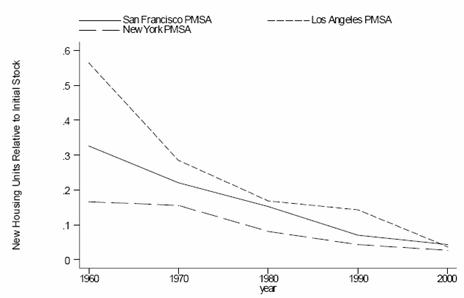
According to a research by Harvard Institute of Economic Research, “Why have the house prices gone up? ”, the key reason to the rise in housing prices is relative to construction costs. Because of the new construction has declined sharply in high price locations, the supply curve shifted to the left.


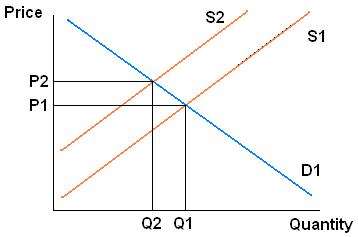
The left picture above is declining construction intensity in select high house value markets San Francisco, Los Angeles, and New York PMSAs, 1960-2000, from the research of HIER, “Why Have The House Prices Gone Up?” The right graft is the possible effect that the declining construction intensity in select high house value markets caused. As less house producers would like to build and supply houses because of the high cost, the supply curve shift to the left. As a result, the prices have gone up.

Of cause, the house market is a really complex market which was affected by all kinds of variables. The analyse I gave about is just a rough one. In the research of HIER, they built a model of house market and use a more accurate way to find the reason. That is beyond what we have learnt right now.

The Social Reprecussions of Abortion

Abortion is a very controversial issue. There are people on both sides that feel strongly about it. Recently there was an article written in Newsweek discussing abortion and how Americans tend to feel about it.

It isn’t so much this article that poses an economic question for me. What I would like to discuss here is an observation that I read about over winter break; something this article reminded me of. In the book entitled Freakonomics: A Rouge Economist Explores the Hidden Side of Everything, Steven D. Levitt and Stephan J. Dubner claim that the decrease in crime rate in the 1990’s was partially caused by Supreme Court Decision in Roe vs. Wade allowing women to have abortions. Their argument was somewhere along the lines of that most of the women who choose to have abortions are low income, low educated, or simply do not want a child. Being raised by a mother like this has been found to increase the chance that the child will have limited opportunities and will have an increased likelihood of turning to crime. Therefore, by allowing these women to have abortions, the crimes these children would have committed aren’t being committed; which in turn led to a reduced crime rate for the rest of society.

As I read this a couple of months ago it intrigued me and I was wondering what others thought about it?

Profits Set to Soar in Outer Space

We've all heard of the possibilites of tourism in space. Some of us, I'm sure, have even imagined ourselves walking on the moon. And I'm also sure that most of us are familiar with the true Luna Park, the amusement park actually on the moon in Futurama. However, it seems like all of this might be closer than we could have thought.

At one point, our space program was all about beating the Soviets to moon. However, there were no real economic reasons to return. Now, though, it seems like space travel is going to be the up-and-coming ultimate vacation. The possibility of bringing in billions of dollars in revenue is leading an effort to invent things that would benefit civillian space travel, like a tourist carrying spacecraft. And of course, all of these inventions would have their rewards.

So, quite a few agencies, including the federal government, are shelling out dollar after dollar into reaching for this far off goal. Is this really going to be worth it?

Wednesday, March 01, 2006

"Firefighters let home burn because fees weren't paid"

" MINNEAPOLIS – Carl Berg failed to pay a $25 annual fee for rural fire protection and, as a result, firefighters let his house burn to the ground last month near International Falls, Minn.
Along with his daughter and a grandson, Berg escaped the fire.
"I lost everything else," he said. "Stand and watch it burn was all I could do. . . . They should have put the thing out, but they didn't."
Some area residents are expressing outrage about a system that can let that happen – and about a dispute involving the International Falls Fire Department, Koochiching County and the Rural Fire Protection Association, which collects annual fees and pays the city for each fire it fights outside city limits.
"You either buy it or you don't have it," said Don Billig, the association's secretary. "


It is outrageous that firemen allowed a building to be burned to the ground. I thought that the tax could have been collected after the fire. But the thing was just happened!

I’ve found out the information that this kind of fire protection association used to be fairly common in rural areas on the internet. I’ve no idea why the fire department didn't offer to put it out for an "emergency fee." So in that way, you could either pay $25 annual fee or you could sell the fire department while it still worth something to pay. But I don’t think that this would hold up in court.

Demand for Marijuana

After class today when we were talking about products that are illegal to buy and sell in our country, I started to think about what the effects would be if some of these things were all of the sudden legalized. Would the demand curve shift left or right? Whether or not marijuana should be legalized is a debate that I'm sure we've all heard about, but what is the economic side of the picture? In an article I found on www.about.com, someone asks a question about marijuana legalization. The opinions as to whether this would shift the demand curve left or right varies. The author of the article thinks that the demand would go down because it is not as "cool" when it is legalized. The U.S. Drug Enforcement Agency thinks that the demand for the drug would dramatically rise as a result of being legalized. In a report called "The Budgetary Implications of Marijuana Prohibition, Jeffrey A. Miron, a Professor of Economics at Harvard University suggested that the demand for marijuana would depend on the price, which is true of many things bought in the U.S. In a report called The Economics of Cannabis Legalization, Dale Gieringer, suggests that the demand for marijuana would likely go up after legalization and even suggested another interesting point. He says, " Legalization of cannabis would also divert demand from other drugs, resulting in further savings. If legalization reduced current narcotics enforcement costs by one-third to one-fourth, it might save $6 - $9 billion per year."
It seems that everyone has a different opinion on this topic, but I wonder what really would happen if things that are illegal to buy and sell (marijuana, organs, babies, etc...) were all of the sudden legalized?

Tuesday, February 28, 2006

ITT Tech is starting to look like a good option

According to this article posted on CNN.com, depite American companies shifting their technology and business overseas, technical jobs are in supply in the United States right now in jobs like graphic design.

These jobs are supposed to continue to remain in the United States in bulk, but , "One of the greater threats to IT growth in the United States is the belief by many parents and young people that the field does not have good job prospects, which has resulted in a decline in students choosing to study various IT fields."

Basically, the quanity of jobs is greater than the quanity demanded, causing a surplus of IT jobs.

How as a country can we get this to shift back into equilibrium?

Being tall has its benefits!

Does being tall help out more than just being able to reach things on the top shelf? According to economist Steven Landsburg it does. On average, he discovered that for every extra inch of height means an extra thousand dollars in a persons salary. Therefor, if you are 6 feet tall you would earn $6,000 more dollars a year than an equally educated and qualified individual who is only 5'6". Tall height not only plays a roll in the salary one makes but also in leadership roles in our society as well. It is proven that of 43 presidents only 5 have been below average height (the last president below average height was Benjamin Harrison elected in 1988). It has also been proven that most presidents have been above the average height by several inches. So does this mean that short people see tall people as authoritive figures, or just that tall people see themselves as authoritive figures? Could height also have a correlation with better self-esteem or mean that someone is better nourished? I personally think that height plays a very small role in the amount of money made and in leadership ability, but I must admit I can't think of the last "small person" I viewed as a person I should respect because of their size. At the same time, I can think of several extreamly tall people who have walked into a room and I immediatly noticed them, and most likely respected them out of the simple fact that if they wanted to, they could knock me into the ground with their fist by hitting me on the top of my head. Decieding if you think height has a very little impact or a large impact in our society is up to you, but I think I am going to go start growing.

Monday, February 27, 2006

Raise the Minimum Wage? Oh No?


Before today's class, I viewed minimum wage as a good plan in helping those who are impoverished. I thought that all minimum wage did was make sure business owners were taking care of their workers. I looked on the internet and found this article on minimum wage. The author talks about how Congress is discussing raising the minimum wage by $1.50. The author says that most unions and liberal anti-poverty organizations are for this change. The author presents the opposing side being mostly business communities and conservatives. He also quickly shows that little evidence has been found that an increase in minimum wage makes unemployment rates rise.

I thought this article highlighted a couple important things to the reader. First of all, it is very clear where the author stands on the idea of raising minimum wage because he takes very little time to show the negative side to this $1.50 raise. He also stereotypes those opposed as "conservatives" and "business communities," making the opposing side look as if they are afraid of change or looking out for the business first. The author also says that "minimum wage are generally supported by unions and liberal anti-poverty organizations." This makes the reader think well the unions and anti-poverty people are for it so it must be good. I would be really interested to see the figures on who supports a raise and who doesn't.

There is also no suggestions for an alternative plan. I think that articles like this are what makes people not think about the economics of a situation. The economics are clearly not well represented. If this raise to the minimum wage does happen I have a feeling many people will be confused by the reverse affect on the market.

Thursday, February 23, 2006

US Figure Skater, Sasha Cohen, Fails to Grab Gold

The women’s figure skating Olympic competition was finished up tonight. It had an unpredictable end with an unexpected Japanese skater, Shizuka Arakawa, grabbing the gold medal. Both of the top contenders, Sasha Cohen from the United States and Irina Slutskaya from Russia both failed to come through in their long program performance. Sasha Cohen was in first after the short program over Irina Slutskava by just a slight amount. The gold winner, Arakawa, ended up beating Sasha Cohen, the silver medalist, by eight points. The article says this about Sasha Cohen: “The successor to Michelle Kwan as national champion has all the makings of a superstar, but she can’t break through when the stakes are highest.” She failed in the 2003 and 2004 national championships, the 2004 world competition, and the Salt Lake City Olympics to take first place. Some athletes might get discouraged from having so many chances and never being able to pull through. I do not believe that Sasha Cohen should not look back on these negative experiences. I think that her missed chances to claim a first place or gold medal could be viewed in the same way as sunk costs. They are all in the past and there is nothing that Sasha can do about it. If she decides to enter more major competitions she should enter without any hesitation and forget about her previous failed opportunities.

7 Efficient Habits

This article (which I am sorry if you cannot read the whole thing) gives a lot of great advice! The article is by Andrew Reese, a Supply and Demand Chain Executive, who interviewed a man named Jim Tompkins. Tompkins is the CEO and founder of Tompkins Associates, which is a consultancy and systems integrator. He has helped companies for over thirty years to achieve the most efficient supply chains.

Tompkins' seven efficient habits starts out with communication. He suggests that everyone within your company, in all departments, should understand what supply chain means, what the objectives are, and the "who, what, why, and where." "There should be no surprises as to what you're trying to accomplish," states Tompkins. The second suggestion he has is benchmark. This means you need to have a "framework" to base your strengths and weaknesses off of. To do this, you need to look at your competitors and what your industry is doing. Tompkins says to ask, "What the best-in-class companies are doing." Third on the efficient habit list is assess and partner. This is where you identify which areas to improve. When your company is up to par, then you are, "partnering to do visibility," as Tompkins says. Fourth habit is prioritize. Here you need to identify specific processes that you need to improve, but it is not as easy as it sounds. You need to look at the processes from different points of view to understand exactly what needs to be improved. The fifth efficient habit is lead, don't just manage. Leadership majors will be pleased to hear this little fact that Tompkins threw out. He said, "What you will find is that they're about 95% management and only 5% percent leadership." To explain what Tompkins said in this section, I can only think of one thing and that is Madonna. She has reinvented herself over several decades and young boys are still hot for her. That is leadership in Tompkins' eyes; reinventing yourself when you are number one so that you do not just disappear after your hype is gone. The sixth habit is add value by focusing on core competencies. This mean that you need to focus on what the customer values, which gives you the market position. The seventh and last habit is to continuously improve. Tompkins explains this step very plainly, "Step 7 would be, return to Step 1 and do it again." He adds that you must do each step more in depth to truly succeed.

Along with the list of the seven efficient habits, Reese put in a selection from a survey. It is the seven deadly sins of supply and demand chain enablement. These are the seven sins:
1. Failing to manage and sustain the adoption of the new technology
2. Enabling bad processes
3. Setting unrealistic goals
4. Trying to enable everything at once
5. Failing to involve supply chain partners in the implementation process
6. Believing in the infallibility of systems
7. Failing to enable the supply chain

All of these bonuses and minuses of the supply chain break down to changes in technology and resources. Wow, my mom was wrong. Economics isn't fiction after all.

Monday, February 20, 2006

McDonald's: not just burgers and fries anymore

Everyone is familiar with the Golden Arches. Everyone knows exactly what they stand for. McDonald’s, the largest fast-food chain in the world, is known for fast food that is inexpensively priced. Well, over the past few years, purveyors of McDonald’s food have begun to witness a change. McDonald’s suffered its first-ever quarterly loss in 2003, the first quarterly loss since the company went public in 1965. Now, McDonald’s is beginning to target a new audience with new healthier food choices. You can purchase a California Cobb salad for $4.50 or a grilled chicken club sandwich for $3.89. With an increase in price, you might think that there would be a decrease in demand and overall consumption of McDonald’s food. However, we have seen just the opposite. McDonald’s saw the average check total increase by 5% to about $5. The company’s annual revenue has grown from $17.1 billion in 2003, to $20.5 billion in 2005. So why is McDonald’s seeing such growth? There are many factors, one may be good timing. More Americans are becoming increasingly health conscience and thus are looking for healthier food choices. The salads, along with white-meat chicken at McDonald’s seem to provide that healthier alternative to a Big Mac and fries. So even though competitor prices or substitutes, such as Wendy’s or Burger King remain low, McDonald’s is still raking in the profits.

Thursday, February 16, 2006

Don’t Turn Right Here!

The excitement I had built up for the opening season for NASCAR has disappeared, faster than Jeff Gordan going around a quarter of a mile track. If you planned on tuning in to watch the Daytona 500 for the intensive driving don’t bother. Tony Stewart, who won the Nextel Cup championship last year, is “crying” because he thinks the “bumping and banging” is out of control. He failed to mention that last year he used this method to win a couple races. NASCAR agreed with Tony and Nextel Cup officials said they would be policing bump drafting. I’d hate to be the official who tells Dale Earnhardt, Jr., who might be in third or fourth at the time, has fresh tires, and only having fifteen laps to go that he’s been penalized for bump drafting in a wolf pack of cars just to gain positioning. Nextel Cup officials say that the penalty could range from driving through the pits to being parked. I guess the officials forgot what racing was. I remember what the crew chief for the movie “Days of Thunder” said. Cole Trickle’s crew chief said, “Rubbing is racing.” This new ruling is not going to enhance the excitement of racing. If this rule sticks the demand for a ticket to watch dirty racing is going to fall. The opportunity cost for the extra safety of Nextel’s driver will be a decrease in the fan base. Do you agree that if NASCAR imposes this rule the demand to watch races live or on television will decrease? Also, if they find out that this rule causes revenue to decline will they get rid of this rule before they lose sponsorships?

PRESIDENT PORTRAYS SOCIAL SECURITY SHORTFALL AS ENORMOUS,

The Bush adminitration, along with the currrent Social security Administration, have claimed that S.S. will face a shortfall by over $3 trillion within the next 75 years. And on top of that, projections for Medicare shortfall are as high as $68 trillion. Know there is no dought that we could have a S.S. and/or Medicare crises on hand in the distant future. But are the numbers that the administration released accurate. S.S.A. Claims that expenditures will overtake income in the year 2018. More plainly said in the year 2018 Social security will go bank-rupt. With the baby boomers reaching the age of retirement S.S. is faced with the situation of paying benefits to the massive retiring baby boomer generation while still keeping enough in the trust fund to account for those 20 Years old or younger. Now, I want to bring into prospective how the number 11.1 trillion came into play. You have most likely heard that S.S. expects a $11.1 trillion shortfall over the year infinity. First off, if it's over infinity years we simply have have to put back $1 every year over the next 11,100,000,000,000 years and the problem is solved. Seriously, even I can afford an extra $1 a year. So, according to what the S.S.A. and Bush administration has said we really don't have a problem at all (not to mention the $11.1 trillion deficit was derived from the fact that the average person will live to be 150 years old and spending about 80 years in retirement). Will Social security have enough money in the future? S.S. has survived WWI, WWII, The Cold War, Iraq (both times), The Great Depression, Vietnam, Korea, Watergate, and so on. My point is, social security has with-stood the test of time, in my opinion it's the most successful bill ever passed in America (singed into action by FDR on 8-14-1935). I'm not suggesting to change social security (or Medicare), I just want want to point out the fact that if we go by what we have been told I don't see any immediate threat to social security. Even thou I don't like higher tax rates, it would be an easy fix to the problem. Bush, however, fills that privatizing Social security is the answer to our problems. Lets say you work for 15 years for the same company, then all of a sudden it moves offshores; now you're stuck with a job at Burger King, how good will your retirement be if you can't even afford to pay money into a private account. Private accounts may work in some situations, but I ask what do you do if your private investment fails?

Chrysler Offers Dealers Cash to Take Cars

Chrysler recently offered $1,000 for every car they sell over the next two months if the dealer doesn’t cut its March vehicle order and accepts cars from the automakers bank of overbuilds. Chrysler is offering this to dealers due to sluggish sales of pickup trucks and SUV’s. There are costs and benefits for both the dealers and the Chrysler corporation. Although Chrysler’s offer will cost a thousand extra dollars for each car, they are concerned about their image on Wall Street if they were to stop production at the plants. Essentially, Chrysler would be “saving face” if they were to keep the production up, which is the benefit of this extra $1,000. For the dealers, with interest rates rising it is costing them more to hold inventory and this cuts into their profits. The obvious benefit would be the extra $1,000 on each car the specific dealer accepts. This is a prime example of how businesses, large and small, weigh the costs and benefits of all of their decisions.

Wednesday, February 15, 2006

NASCAR's Daytona 500

The Daytona 500 kicks off this Sunday (Febuary 18th, 2006) afternoon, and NBC has reported that there will be about 18 million home viewers. NBC is hoping to set a new high, and has heavily promoted the race. There are a few major companies, such as, Coke and Pepsi; Lowe's and Home Depot; Chevy, Ford and Dodge; UPS and FedEx, all fighting for a 30 second slot worth an estimated $425,000. Do you think this slot is worth the money? Read the article, and comment about the idea of airing NASCAR's first Black History Month ad. Is it a good idea to break up the Olympics with NASCAR's Daytona 500? Do you think the interruption of the Daytona 500 is going to hurt/help either the Olympics or NASCAR's ratings? People may not tune into the Olympics after the long day of car racing, on the other hand, people may watch the Olympics after.

Cleveland Browns to make splash in free agency?

With possible free agent acquisitions such as Defensive End John Abraham and Shaun Alexander, perhaps even Lavar Arrington, the Browns and their 25 million expendable dollars figure to make themselves into a contender via free agency. However, it can be argued that spending loads of money in the free agent market will ultimately kill their bottom line. They have sold out ever game since they came back to Cleveland in 1999, and attendance has nowhere to go but down. This would seem to imply that the Browns owners are more committed to winning than to the bottom line. My question is that do you feel that spending this extra money will affect the bottom line negatively or positively. I maintain that it will positively affect them because of all the playoff compensation that seems iminent.

New Roof: Worthy of Taxes?

The Cleveland Browns' stadium is under consideration for the addition of a $90 million retractable roof. How is the city planning to pay for this? Well, the same way they paid for the stadium in the first place: taxes on cigarettes and alcohol. This "sin tax" is being used on something that is as seemingly trivial as a retractable roof for an already new stadium; it seems that perhaps better use of these funds could be found. However, these planners do have the economic well-being of the city in mind. They feel that this addition to the stadium would put them in a position to host a Superbowl in the next 10 years. This would be a tremendous boost to the local economy, such as can be seen in Detroit this year. However, one-time events cannot solve deep-rooted economic difficulties. Do you think that the new roof is worth the $90 million in tax money, or should these funds be used in other ways? The information for this post can be found at: http://www.newsnet5.com/news/7056180/detail.html.

wage increases

Here is one thing everyone can be happy to hear, higher wages! In this CNN article economists are now predicting a raise in the average wage rate. The unemployment rate fell to 4.7 percent this Friday, the lowest level since July 2001, just before the Sept. 11 terrorist attacks. Now 65% of US workers say that they are considering looking for a new job. Economists are also saying that with the switch in job people can expect a 10% increase as part of the move. With the increase in wages companies are now worried about employees leaving. Forcing more company’s to be more generous with raises, and bonuses. This is a clear shift in demand. The market for labor has a higher quantity and a higher price do to this shift. The worry on Wall Street is that the raise in labor costs will lead to a pick up in inflation. What we think is a great wage increase is not as great as we think. What are some things the government can do to prepare for the pick up in inflation? Or is this problem just inevitable? Will it work it’s self out?

The Corporate Olympics

The Twentieth Winter Olympiad is underway in Turin, Italy, and while the athletes and spectators from around the world are competing at their highest levels, the organizers of the event are breathing a larger sigh of relief than any of the athletes who have won a gold medal. Turin's olympic organizers are celebrating their getting the 2006 winter games under budget, though it seemed to be a struggle to the last day, with organizers not knowing the day before the opening ceremonies if the costs would be covered.
The olympic operating budget for the Turin games is estimated at nearly one and a half billion dollars, a staggering sum, given the events last the whole of three weeks. But, how does one smallish town in Italy generate that much operating revenue to cover the costs of the games? The wonderful world of corporate sponsorship and television broadcast rights, that's where.
Of the 1.5 billion in costs to operate the games, 40 percent will come from broadcast rights paid for by NBC and its enclave of international broadcast partners for the event. Corporate sponsors will account for 39 percent of the Turin games' revenues. As for tickets, they will account for 6 percent of revenues, half of the amount tickets accounted for in the last Winter Olympics, set in Salt Lake City.
These monies are part of major deals signed with the International Olympic Committee, some far in advance of these games. NBC, for instance, paid 3.5 billion for the rights to 5 Olympiads, starting with the 2002 Salt Lake City games and going until the 2010 Vancouver games. 11 other major multinational companies signed similar long-term deals, to the tune of $173 million over the next 2 Olympics. In addition, 4 major Italian companies, including auto manufacturer Fiat, are kicking in 50 million each, with even more coming from other companies providing cash or services to the Turin games.
And yet, even with all of this money flowing in, the budget for the games was still in a $24 million shortfall as recently as late December. Organizers struggled to meet budget, having to seek approval to sell scratch-off lottery tickets to cover some of the costs. Still, some localities around Turin will have to pick up any remaining slack that may remain even after the lottery funds come in.
With the ever increasing pressure for Olympic host countries to outdo their predecessors, the costs of the games are becoming so astronomical, people who see these staggering numbers scratch their heads in wonderment of how so much money can be sunk into the games themselves. While it would seem that countries want to build stadiums, for instance, that could be practical afterwords and not be Olympic only venues, most structures of recent Olympics have become those "white elephants" that organizers want to avoid. One such venue from the 2004 Athens games, for instance, is now used as a weekend flea market - albeit a $400 million dollar flea market.
Do the Olympics need to be such corporate festivals? Does the excess cost really make an Olympiad that much more exciting? And, do you think the mindset for countries to out-do one another will become too uneconomically feasable to support?

Johnny Damon a Yankee: good thing for the Red Sox?

As many baseball followers know, Johnny Damon joined the dark side this year for $52 million dollars over 4 years. The Red Sox best offer was 4 years $40 million (the same offer they gave Jason Varitek and Edgar Renteria the previous season). The Red Sox believe Johnny Damon was not "worth" $52 million dollars. I ask the Red Sox to define "worth". Is Johnny Damon not worth $3 million more a year? Did the Yankees pay too much for him? Was Johnny selfish? The whole "worth" thing gets to me. Damon said he loved the fans of Boston (rightfully so they created him). He was THE MAN in Boston. Damon is arguably one of the best leadoff hitters in baseball, a major threat to any opposing pitcher, and a great guy in the clubhouse.

The Red Sox just have a poor excuse. According to one of Dr. D's lectures, ticket prices influence salaries. The Red Sox have the highest demand from fans of any team in sports. The Sox sell out every game, have a season ticket demand larger than anything anyone can imagine, and their prices are through the roof. The Red Sox fans are willing to pay extra to go to games to see the players, the rivalries, and championships. Johnny Damon brought in a large amount of revenue to the Red Sox. His jersey sales were among the leagues highest. Now all that revenue goes to New York because they thought Damon was worth more.

Ok, the "worth" part of my blog. There were two big name leadoff hitters that were free agents this winter. Rafael Furcal and Johnny Damon. Damon is by far more productive than Furcal and has the stats to prove it. Furcal signed for 3 years $39 million one month before Damon got his contract. To Damon, he was "worth" more than Furcal. Damon wanted a salary equivalent (or better) than Furcal. Is Damon worth $52 million? Is Furcal worth $39 million? What am I worth? Who decides my value? Does the Yankees paying Damon $52 million make him worth $52 million? I would say yes because he getting paid that. The Red Sox do not think he is worth $52 million and chose not to pay him that. For that they lose. What does Johnny Damon being on the Yankees do to Red Sox revenues? Probably increase them because all the fans that bought Damon jersey last year will go out and spend more money on Damon Haters shirts and Coco Crisp jerseys. The money the Red Sox saved by trading for Crisp (who makes $3.75 million per year) allows them to go after other players. What it comes down to is that Johnny Damon IS worth $52 million because someone paid him that amount, just not the Red Sox. The Red Sox will still sell out, still raise ticket prices, and still have a list of over 1,000 people waiting for season tickets.

How big will scaled-down Mardi Gras celebration be?

This article speaks of the devastion Hurricane Katrina had on New Orleans and how, if at all, they will be able to bounce back and be prepared for the Mardi Gras celebration this year. Mardi Gras has always been a huge ordeal in New Orleans that cultivated over $1 billion visitors each year for its 12+ days of celebration. Sadly enough, after the devastation of Katrina, the town is unsure what to expect in the shortened celebration of 8 days. A problem seemed to be presented is the vacancy of hotel rooms, since many are occupied by those families made homeless by the hurricane, as well as recovery workers. Many townspeople and officials say they honestly do not know what to expect, but they are certain that although this may not be the largest Mardi Gras ever it will definately be the most emotional. The city is hoping for a decent crowd, because the larger the crowd the more income the city will get to continue it's fight towards restoration.

Tuesday, February 14, 2006

Toronto Could See Sports Monopoly

In 1998, the question was posed, "Can whom ever owns the Skydome in Toronto Canada develop themselves into a monopoly"? This questine in 1998 can be asked today however with a little more knowledge. In 1998 the Skydome and those who owned it were losing money and bacame broke in a corporate sense. In the article they compare the Expos and the BlueJays. As one might know now, there is no longer a Montreal Expos baseball team, however there are still the lonesome BlueJays in the midst of a country with enough fans to possibly monopolize. My question is that, can the new owners of the Skydome pull off a giant monopoly of sports in Canada? Turner, the media company whom already owns the Atlanta Braves already has one synergy or owns a team plus the media coverage, may possibly interested in the purchase of the Skydome and BlueJays. With that in mind, Let's recap. If there were a synergy with Turner and the Toronto BlueJays, being the only team in Canada, just think of the profit which could be made. The article also posses the question, "what if one person obtained the Leafs, Raptors, and BlueJays along with the concerts and what not the Skydome and Air Canada Arena hold?" The article directly states, "The area around the stadium and the arena, would become one big sports and entertainment complex. The television network would have first crack at what amounts to nearly a game a day during the calendar year." Is there a possibility for a monopoly?

Economics of MLB All-Star Game

The football season has come to an end with the Pittsburgh Steelers's victory in Super XL and many sports fans are beginning to look forward to the baseball season. In particular, the city of Pittsburgh and all Pittsburgh Pirates fans will prepare for a decent season (hopefully) and the 2006 MLB All-Star game to be played on July 11th at PNC Park. In an article I read from the Pittsburgh Post Gazzette, city officials are expecting an image boost as well as a major (and very much needed) economic boost from the game and week-long All-Star festivities. The city is currently facing a $78 million deficit and, with estimated revenue numbers from the past 2 All-Star events at $85.6 million for Houston and $50 million for Detriot, hopes to dramatically better its financial situation. However, repairs, landscaping, construction, and many other beautification projects must take place in order for the city to host a successful (or even decent) event. No doubt such projects will generate jobs, but is the city able to fork out the money without guarantee that it will break-even or profit from the game? I believe that Pittsburgh was given the most excellent oppurtunity to recover from its economic slump through the 2006 MLB All-Star week. The Pirate ball club and PNC Park will be making big bucks from the rise of season ticket holders who purchase the package just for privelleges at the All Star game and from the pricey All Star game tickets. However, most of the revenue from the game will not come directly from PNC Park or the Pirates club, but as a result of the trickle down effect. For example, many area hotels, businesses, airports, parking vendors, etc. will generate a reasonable amount of profit.

Monday, February 13, 2006

Highway Markers Honor DUI Victims

Georgia governor just passed a state law that puts up a memorial sign for all the victims of drunk driving accidents. The first one was just put up, and they are hoping others will see the signs and say "Well, there really was someone killed by a drunk driver." The signs are about the same size of a speed limit sign, and officials are trying to send a message out that is more personal. So far only eight victims' families have asked for a sign to be put up. Some families don't want a sign put up if it is a road they travel on frequently. Other roadside memorials (flowers, crosses, etc.) are becoming "garnish shrines" that can distract drivers. They are hoping the new signs will not distract other drivers and cause more accidents. State officials are just trying to get the message out that drunk driving causes many fatalities that never should happen. No one knows if the signs will really help decrease the number of fatalities, but it is worth a try.

General practioners

This article discusses two important parts of the medical field, general practices and general practioners. In the first part of the article, it discusses how governmetn funding is used to fund general practices. This is an example of government stepping in to make sure the markets are working correctly, if they are not leaning towards equilibrium. The second part of this article discusses who general practioners rely on to get paid. The article mentions that they rely on the person sitting right in front of them. This is an example of personal decisions interacting in the market. The patient going into the doctor is seeking medical attention, while the practitioner is looking to gain money by taking care of the patient. This is also a trade-off between these two people!!

Crime Doesn't Always Pay

After Hurricane Katrina reports of fraud and scheming were almost immediately in the news. Hundreds of people or maybe even more, driven by greed, opportunity and disaster came up with a multitude of ideas of how to get more money. Most of these reports were about how individuals attempted to get money from FEMA under false names or insurance for houses that never existed.

In contrast, a group of 49 Red Cross workers and their family members have been indicted in a scam to steal Red Cross hurricane relief funds. These people who were part of an organization based in helping people took an opportunity to help themselves. These people are charged with tapping into the system and creating fake accounts then had family members receive these.

In this case crime really has not paid off, at least for these individuals. They choose something without thinking about the marginal cost and marginal benefit. They most likely did not know how likely it was to be caught because of the individuality of this crime yet the Red Cross was offering $360 for individuals but more than $1,500 for families. This is a small fraction of the amount these individuals were most likely making in their every day lives, by working or retirement. In addition, these people are now facing not only fines but also jail time. This attempt to get rich was not rational and to this individuals not profitable.

Rising Gas Prices

One of the most popular topics of conversating in the US has been Gas prices. The US experienced hikes in gas prices largely in the past because of Hurricane Katrina. It was interesting to see that the British are also experiencing a rise in gas prices. After reading this article, it makes one wonder if the increases had to do with the destruction caused by Hurricane Katrina or because of a global shortage. As the article states, Britain's reserves meet only 4% of annual demand. Perhaps we should focus more effort on new ways of fueling our cars.

VW cuts jobs

In Frankfurt Germany volkswagon said over the next four years, it plans to cut over 20,000 jobs. Inturn this willl make the company more profitable and bring ina better revenue. Although this plan looks goood from the VW perpesctive, it may not be such a good idea in the long run. These 20,000 that will lose their jobs will be forced to find work elsewhere, but what if they can't? Jobs are scace and the fact is that if some don not find jobs, then that could have a big effect on the econommy in Germany.

Air China Come into the Market

Last Friday, Air China Ltd which is the largest aircraft company planed to sell 800 million dollars count as RMB in Class A shares. Air China will collect money for new aircrafts or to develop the Operation Center in Beijing.
Air China announced that, they will use the money to expand the collection of aircrafts, which includes 20 A330-200, 15 Boeing 787 and 10 Boeing 737-800 aircraft. More than this Air China will invest the Beijing Capital Airport’s rebuild project, which needs about 7.45 million dollars.Air China would apply to come into the market on March. If they got approved Air China would be the first company that allows to issue this kind of stock since Securities Regulatory Commission suspend this on April, 2005.

As the largest recognized Airline Company, Air China plans to collect money form the stock to enlarge its business. It’s a big action for a huge company that own by state.

Considering the Possibility Curves of Costumers

There is a germen restaurant in Augsburg called the “Boheme”. They do not allow young children to eat dinner at his establishment. The reasoning for this is that children will whine if taken to a restaurant at night and therefore drive off costumers. At the same time this rule prevents the restaurant from accepting costumers who cannot find someone to take care of their children while they go out on the town. In this sense there is an opportunity cost attributed to having the costumers with children, as it would drive off costumers who dislike the noise that might occur while they eat.

The restaurant does allow dogs inside the establishment, though. This raises the possibility that, lacking suitable dog free rooms, they will lose the patronage of people with allergies, and perhaps others who simply do not like dogs. In the best case scenario the restaurant would have enough room to set aside areas for dog lovers and people with young children, but it is far more likely that the restaurant exists in a building with a limited amount of property for such things.

United States cutting in on Australia's turf?

Following the destruction of Sadam's regime in Iraq, the United States became a contender for the Iraqi oil-for-food program, an institution that allowed food and other humanitarian aid to be shipped into Iraq in exchange for oil. For a while now, Australia has been a major benefactor of this program, exporting a 3/8thsof it's total wheat production to Iraq (2.5 million tons).

However, Iraq recently announced it was canceling it's long standing business arrangement with Australia and is now shopping around for new suppliers. I'm sure that the steady and reliable arrangement with Iraq had been factored into Australia's economic models and has influenced their production of wheat over the years (average annual average 16 million, this year 24). Now that their usual market has been sharply cut off, what will Australia due without the trade benefits? Is it that big of a deal? How much where they counting on that oil? Questions, questions, questions.

2005 trade deficit hits record of $725.8B

Mainly due to a record high in importing crude oil, 2005 saw an overall record of a $725.8 billion gap between American imports and exports. The trend of an increasing trade defecit has drawn on for four consecutive years. With the trade deficit at an all-time high, one has to wonder if those in charge of foreign policies have noticed the trend at all. Economists are split over whether the gap will reach a trillion in the next few years but it seems dependent on who the next president will be. As long as we stay in the Middle East, our overseas relations will not be as great as we'd like them to be. But with recent talk of a free trade agreement with South Korea and the growth of other foreign countries, I can see how the decifit will eventually level off. However, Democrats argue that opening up free trade agreements will cause more Americans to lose their jobs, as 3 million have already suffered from unemployment since mid-2000.

I agree that the numbers are pretty alarming, but they are a little inflated due to the fact that we are importing abnormally large amounts of crude oil these days. The high price of the oil also has a significant affect on the numbers. But regardless, America needs to look more inward in regards to the economy and increase the amount of exports. I've only been in an economics class for a few weeks now and I know that there are significant gains from trade. So unless we are getting the full bang for our buck in having such a large trade deficit, something has got to give.

Sunday, February 12, 2006

These days, there are visible changes in Korea

These days, there are visible changes in Korea.
Above all, “The Bank of Korea” raised its overnight call rate by a quarter percentage point to the highest level in three years. Some experts said that the truth is hardly surprising, call rates are increasing. As well as, some economists expect the Bank of Korea to increase the rate at least once more this year. The central-bank governor, Park Seung, also said that at 4% the rate still supports economic growth but is "very close to being neutral. He is convinced that he is right.

But I think there is another problem in the situation. At first, the bank's move came despite concern over the rising value of the nation's currency and despite fierce political pressure from the government. A stronger won hurts exports, a traditional engine of economic growth because it makes South Korean goods more expensive abroad. It could be a deathblow to Korea’s foreign trade. However there are a lot of South Korean companies, especially small traders, concerned about the won's gains. Samsung Electronics, Hyundai Motors and other corporate giants have hedged their currency bets,

Speaking to reporters after the rate increase, Park, the central bank governor, said a rise was needed to fight inflationary pressure since South Korea's economy is recovering faster than expected because of strong private consumption. Likewise there are many things to figure out. The Bank of Korea has to do something to solve the problem.

Volkswagon Layoffs bound to reach 20,000 workers

In this article, Volkswagon is going to get rid of 20,000 workers to continue with a higher technology and make of cars. Because of this huge amount of layoffs, the economy will need to be prepared to have more availability of jobs for these 20,000 to make it in the world. I wonder if the workers that know they will not be there anymore will stay there until they are told to leave, or if they will just leave Volkswagon in a hunch and leave without their work complete?

Mining Fines Among Smallest

MariettaEcon

During the 2004 Super Bowl Janet Jackson had a wardrobe malfunction in which her breast was exposed. As everyone knows there was a large fine of $550,000 for the mishap. When it comes to being fined, it is common sense that a mishap resulting in death should be more consequential than a mishap resulting in indecent exposure. Although this does appear to be common sense, it is not. In 2001 13 miners were killed in an Alabama mine and the consequence for the terrible malfunction resulted in only a $3000 fine. Though the fine did begin at a price of 435,000 dollars, it was reduced to $3000 because the problem was fixed. As a result, many investigations have been made to strengthen the consequence of low worker safety at mines. A minimum fine of $10,000 has been proposed but if we are going to charge hundreds of thousands of dollars over a wardrobe mistake then we need to rethink what we are focusing on because death is obviously more important!

Delta cancels East Coast Shuttle Sunday

Delta Airlines has canceled flights to the eastern seaboard because of snow. It has not been a bad winter as far as it goes for this year (meaning a steady turn of flights). The airline is allowing its customers that have been delayed to schedule flights that will not have any incurring costs. This is a sunk cost to the passangers of Delta Airlines. The passangers have already invested time and money for the trip previous to this event. By gaining the ability to get to their destination in an aternate way, the lost time is a sunk cost. Delta hopes to capture some loyality with those delayed because they are able to satisfy their customers with not charging they to go an alternate route. They feel they can do this because of their ability to accomeadate the customer. Also they feel that they can capture some main frame clients through the big city locations. If you are able to serve a client then you have served your target market successfully. Taking on some additional costs to effectively serve is a must in order to stay strong in the Airline industry today.

What do you think this will do to Delta Airlines? Are the costs, taken on due to the delays, sunk costs for passangers, why or why not? What effect might this have on Delta Airline's PPF? If you were to make a decision for Delta on how to fix this situation, what areas might you be able to effectively use your resources?

Is mariage worth anything?

Many people have said being married is a pain. However, researchers have said that marriage can actually save people money. If someone lives alone, they buy groceries for 1 person, however, usually the servings are enough to feed at least 2. When a married couple goes to buy groceries, they spend the same about. But they are both eating. It is also cheaper to house a couple than 1 person.

Rent!

New York City has been known as an ideal place to live. It has plenty of night clubs, tons of shops with designer labels, some of the grandest landmarks in the world. However, nowadays, all that luxury comes at a high price. Rents are increasing, renters incomes are going down, and the number of rent-controlled units is shrinking as elderly tenants die or just leave them.

According to the most recent Housing and Vacancy survey, the number of apartments for working-class and poor New Yorkers has gone down by at least 20 percent since 1993. Since that year as well, there are over 112,000 fewer apartments in New York City that rent for less than $500 a month. The median rent for all units in NYC has actually increased by 18 percent to around $593. Victor Bach, a housing policy researcher for the Community Service Society insists that something must be done to prevent low-income people from being evicted due to rent inflation.

Many people dream big of moving to New York City and making it big. Everyone knows that if you can make it there, then you can make it anywhere. However, all must also remember that this city is expensive, not cheap. It does always sound exciting to live in the Big Apple, but if you can't find the money to support yourself and pay rent, then you might run into serious problems. You must always consider how your marginal benefits of living in the big city measure up against the marginal costs of living in an expensive city as well. My advice would be to take a good look at the musical Rent and see how tough it is for some of the characters who hadn't even paid a year's worth of rent at the start of the show. How much would living in NYC really cost someone and would it really be worth it?

Mardi Gras Returns to the Big Easy

The Mardi Gras celebration returning to New Orleans this year should turn into a huge economic boost for the area. It is awesome that residents and local organizations are poking fun at the situation, even if it is at the expense of some, because this will not only lighten spirits but also attract visitors to the area. Had the celebration been put off this year this huge amount of profit would have been lost. The turn out will undoubtedly be less than normal, but without this boost to the Big Easy's economy revitalization may have taken a much longer time.