Sunday, April 30, 2006

Microsoft-tradeoffs of being a monopoly company

After been accused for breaking the antitrust laws in 2000, a European Commission reinforced that Microsoft violated antitrust laws to "double lock" on PCs.

The Commission found Microsoft was tending to capture 60 percent of the market for work group servers by utilizing its power of 95 percent share of the PC operating systems market.

This case will be ended in months or even next year. If the commision loses this case, "its reputation as Europe's top antitrust authority could be dented."However, if it wins, Microsoft will be forced to give a "worldwide license in perpetuity that involves its patents, copyright and trade secrets."

What caused Microsoft to be a monopoly company? Why do you prefer Microsoft when there are other alternatives available? --Initially, its creativity might let Microsoft become a monopoly company. Then, the size and the development of the company built its reputation. Finally, its reputation caused consumers to buy its products even though there are other alternatives available since Microsoft agreed to do some changes in its selling strategies. This process, however, can be hardly achieved by new companies which are willing to compete with Microsoft.
Therefore, my opinion is, if monopoly companies can set their prices appropriately, it is better to have legal monopoly companies rather than dealing with endless lawsuits.

Anti-Immigration.... Don't we have more important things to worry about?

I'm sure most of us have been made aware of the recent debate over new anti-immigration legislation going through congress. The theory goes that illegal immigrants are depriving Americans from work within our own boarders. These Americans claim they are deprived from work because illegal immigrants are willing to work at or below minimum wage, while Americans aren’t.


Well….why not? If Americans workers are unwilling to work at what is considered to be current market prices, SHOULDN’T they be out of work? Keep in mind, not all illegal immigrants are working at below minimum wage levels. Some of them happily obey the labor laws concerning their employment, well, most of them, INCLUDING paying social security and other standard taxes.

Thus, we come to another conundrum. We have a large, competent labor source working within the boundaries of the United States whose only crime is that they were not born in ‘the land of the free.’ Meanwhile, we have a native born labor source claiming they have the right to the jobs that these other workers are taking, often at lower wages. In response, our native born American citizens have petitioned their congressmen to pass legislation to crack down on said illegal immigrants to secure their jobs.

Thus we have an externality situation. Our American workers claim their rights are being violated by these illegal immigrants working within the labor market and decreasing the market of low paying jobs for their own use. To be the devil’s advocate, from a societal standpoint these same illegal immigrants pay into the social security fund without collecting, pay their taxes, and contribute to the labor force.

From our discussions in class, it is up to the courts to rule on externality situations. Currently, the legislature is moving to make a verdict on this subject, should they? Should we kick out these immigrants at all? Why not reform our immigration policies to make these immigrants legal?

As Carlos Mencia recently commented during one of his comedy shows, “If you kick all the Mexicans out, who are you going to get to build that wall?”

Game Theory and Solomon’s Wisdom

There is a very famous story about Solomon’s wisdom. N the story there are two new mothers, one of which who had smothered her baby during sleep and claimed the other woman’s baby as her own. The problem is presented to King Solomon, who proposes the baby be split in half, each woman receiving one half of the child. The woman who was lying agrees to the compromise, while the real mother immediately feels sympathy for her offspring. Rather than see her child killed, she says the baby belongs to the other woman. Solomon instantly gives the baby to the real mother, realizing that a true mother would compromise to see her offspring survive.
After learning game theory in class, let’s look at this story again. If both of the two women are experts in game theory, Solomon’s wisdom will fail. Assume woman A is the real mother and woman B is the liar. When Solomon asks to cut the baby into halves, A will definitely say no because she loves the baby and does not want to hurt it. On the other hand, if B understands game theory and think rationally, she will make the decision of giving the baby to A also. Now the situation is that both women A and B would like to give the baby to the other. We come back to the origin. Whether Solomon will cut the baby into halves or not, he cannot judge which woman is the baby’s real mother now. Solomon’s wisdom failed after learning game theory.
Is there any other method to solve the problem Solomon faces? Or is it still a puzzle?

Fuji Facing a profit declining

According to last Friday's Wall Street Journal, Fuji Photo Firm Co. said their net profit dropped 56% in last fisical year.
The Japanese company produced all kinds of films and camera in the last decades. Among their products, color-film was their major product. As more and more people turned to use digital cameras, the Japanese company is now facing a big issue: restructuring operations. Restructuring operations cost the company a lot of money, and the company is hit by this heavy cost. Fuji's net profit fell to 37.02 billion yen ($ 322.7 million) from 84.50 billion yen a year ealier.

Ritzy Retirement

Many people fear getting older and being put into retirement communities. After all, the image of retirement homes is really quite depressing. But are retirement communities really as bad as we think they are? An article written by Sara Clemence of Forbes Magazine discusses one of the ritzy retirement communities in California and it doesn’t sound bad at all. This community is complete with gourmet meals, access to Stanford University programs, and the attentive service that some senior citizens need.

Retirement communities can offer people ways to socialize and a variety of activities to participate in to keep themselves stimulated. So, has your image of retirement communities changed? Do you think that there is a demand for this type of service in the US? If there is, does it come from senior citizens themselves or from their family members who are trying to care for them? Do you think that older people of the next generation will be able to afford a retirement community like this; especially with social security on such shaky ground?

I was always under the impression that seniors wanted to remain in their homes with the lives that they built around them. But, I may be wrong. Any thoughts?

Just who does rising gas prices affect?

This article from the New York Times examines all the different people who are affected by rising gas prices across the country. I feel that it is a good article to look at as the year draws to a close because it really brings together a lot of different issues in economics discussed throughout the year, including government intervention, consumer elasticity, substitute products, and externalities.
I'd like to discuss the issues with elasticity that arose in the article. Towards the beginning of the article, several different college students and young adults were interviewed and asked how the rising gas prices affected them. These individuals found themselves driving significantly less than they had planned to earlier in the year, and regretting even employments opportunities they had taken. In one case, a young man was thinking about turning down a good-paying job because of the amount of money he would have to pay for gas. These individuals were all finding that their demand for gas was actually elastic as the prices rose, much to their surprise from their attitudes even at the beginning of the year. Towards the end of the article, however, an individual was interviewed who complained about the inelasticity of his fellow commuters in the Seattle area. Rather than cut down their drivig by taking public transportation or becoming involved in carpools, these commuters simply continue to make the hour long commute from Seattle to Bellevue, much to the chagrine of someone who is desperately seeking out a carpool buddy.
Why is their such a difference in the elasticity of these people? I think it goes back to the idea that items which consist a large portion of an indidviduals budget are much more elastic than lower-cost items. For younger college students, a fill-up at the gas pump has signifiant, immediate results. The cost take a larger proportion of our finances than it does of someone with an established career.

Gas prices could cut sales at discounter, food, teen chains

With gas prices at record levels, retail analysts are worried that low-income consumers will cut their spending at discount stores such as Wall-Mart, fast food restaurants, and stores that market to teenage consumers. The concern is that as gas goes up low-income consumers will have less money to spend. Stores that are discounters', fast food restaurants or teen chains that cater to low-income consumers might have a highly noticeable drop in consumer spending which could be detrimental to their businesses. Low-income consumer spending tends to be highly elastic. If the price goes up for gas, then they'll spend more of their income on gas and less on items that are not necessities. This could also mean that they will begin taking alternative transportation to and from work. If low-income consumers begin taking alternative means of transportation to and from work, they might still have a little extra cash to spend at discounters', fast food chains, and teen chains. If this occurs then the rise in gas prices won't be as detrimental to the businesses that cater to low-income consumers. The article also goes over how higher gas prices will effect high-income consumers and their spending at high end retail stores such as Saks and Neiman Marcus. Higher income consumers tend to be inelastic in their spending so economists expect that consumer spending at high end retail stores will drop a tiny bit, but nothing too noticeable will occur.

It will be quite interesting to watch and see how the higher gas prices effect consumer spending in not only high end and low end retail stores, but also in the travel industry. Will the travel industry in the United States experience a boom as plane tickets to travel to Mexico and Europe sky rocket due to higher gas prices? Or will the travel industry in the United States also suffer due to higher gas prices?

Saturday, April 29, 2006

Mexico: The New Netherlands?

The Mexican congress has passed a law to legalize small amounts of marijuana, cocaine, heroin, LSD, and other drugs, for personal use. The sale of such drugs, however, remains illegal. Apparently, the intent of decriminalizing the possession of small amounts is to focus police and justice resources on bigger fish, so to speak. In so doing this, Mexico is moving toward an approach long used by the Netherlands. The Dutch, however, have only legalized the personal consumption of small amounts of marijuana and hashish. Mexico is entering uncharted waters with their more comprehensive decriminalization.

U.S. authorities have expressed concern that such a policy shift will make it more difficult to police drug activity in the United States. Consequently, we might expect drug users in the United States to respond to the new incentives created by the change in Mexican law. For example, I would venture a guess that Mexico might become a more popular spring break destination for American college students.

Friday, April 28, 2006

Brazil Has Something to Teach Us

Well, if you're one to complain about gas prices, THIS is the article to read. I saw a segment on CNN last week about some sugar ethanol from Brazil being used that was a lot cheaper than gas and better for the environment as well as the economy. Well, of course, I got curious. I searched and found this article that explains EVERYTHING!

Basically, when our country hit bad times with gas a couple of decades ago, there was 100 percent or maily enthanol (alcohol) gas. Brazil produced this also 30 years ago, and they are now enjoying their return on investment. Recently, Brazil has found a way to utilize one of their main resources, sugar cane, as a producer of enthanol. Now, this type of gas today is less than half the price of regular gas and it does not pollute as much. What more could you ask for?

Now, the problem is no country has enough land to produce sugar cane. Therefore, in my creative and imaginative mind (not to mention nieve but just follow me on this) I thought why not each country utilize their own crops that they have more than enough of. THis would be efficent. Well, in my mind anyway.

Another thing about this whole sugar ethanol is that it is a substitute for gas. This would create more competition and drive prices way down because gas is very elastic these days.

Well, that is all I have. Happy Doo Dah Day!

Thursday, April 27, 2006

Bill O'Reilly Is Full of Gas

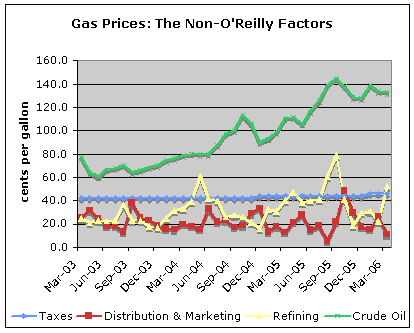
For a sarcastic look at conspiracy theories regarding rising gasoline prices, check out the article by Mac Johnson (linked above). One interesting bit from the article is the chart below.

Record Profits by Oil Companies

Recently, Exxon Mobil, the nations largest oil company, reported profits of $8.4 billion. This number is up 7% from last year. Since Exxon Mobil is the worlds largest oil company, they are setting the price for other oil producers. Although Exxon is not the only oil company, they are setting output and price in a monopolistic way. Output will be set according the rule MR = MC. The price at this point will not be charged however. The price will be set off the demand curve, directly above the maximum output point. Doing this increases producer profit while decreasing consumer surplus. This seems to be exactly what Exxon is doing. Exxon is making record profits, while the general public is outraged that their consumer surplus is dwindling. The government is attempting to solve the problem. It has been proposed that tax breaks to big oil companies be repealed, and new laws against price gouging be passed. Due to the sheer size of Exxon Mobil, it will be difficult for other companies to come in and form a prefectly competitive market. Government intervention appears to be the only solution to the rising gas prices.

The Market and Osama Bin Lauden

How would the market react if Osoma Bin Lauden was captured by the United States? After thinking about this question, I thought that there would be big effects on our economy and our national debt. With the capture of Bin Lauden, the government would be spending much less on National Security because there would be a serious decrease in the likelyhood of a terrorist attack from the Taliban. There would be a decrease in military spending to try and capture him as well. In an article called, " How Would the Market React to the Death or Capture of Saddam or Osama?" this idea is somewhat analized by an economist. In the article, Mike Moffat states, "I think [the capture of Osama] will cause a one to three day rally on Wall Street. I'm not sure if I agree that it will cause any long term changed in the stock prices, however." After this statement he continues to state the the only exception to this is if one of the issues I mentioned above happened as a result of the capture.

Sunday, April 23, 2006

Oil Crisis

After a Category 5 Hurricane destroyed oil refineries in September '05 and wiped out many drilling platforms and pipelines, hard times have come upon the U.S. and China. Not only did this crisis begin an economically rough time, but along with the accomplice of the terrorists attack to two key oil installations in Saudia Arabia. The refinery in Saudia Arabia just happened to be the world's largest supplier. With these two hard hits we are needing to consume more oil than is able to be provided. Not only does this effect the extremely high gasoline prices, but the inflation of food costs as well due to the delivery trucks needing to purchase more gasoline to make the deliveries. Is this a problem that the U.S. and China can fix or will this be the beginning of the drawn out battle?

Friday, April 21, 2006

Not Stop SIgn Yet: Inflation Revs Up


Gas prices rising, this doesn’t only effect how much you pay to fuel up your car. It also effects how much you pay for the goods that you enjoy. Companies across America are having trouble keeping there prices the same, when it now cost them more to produce them, and then ship them out into the market. At the last meeting of the Federal Open Market Committee they planned that at there next meeting that they would bring up interest rates to 5% from the current 4.75%. They hope that this will make more of an ease on the market as it sets now. According to the Department of labor consumer prices have raised higher then their pay.

Business side of Baseball

According to a recent Forbes article via ESPN.com, Major League Baseball's team values have increased an average of 15% for the second straight year. Operating income increased to $360 million from $132 million the year before. The Washington Nationals, who are on deck for a new stadium, reported the biggest gain of 42%.

Another interesting point Forbes makes is about the effect revenue sharing is playing. MLB's league sharing rule states that teams must pay 34% of their net local revenue in order for poorer teams to become more competitive. The New York Yankees paid a record $77 million and actually lost more than $50 million in operating income. The second highest totals belong to the Red Sox who paid $51 million and lost more than $18.5 in operating income. Revenue sharing is the reason why the Oakland Athletics, Minnesota Twins, and Kansas City Royals value increased by more than 20%. The Royals also earned more than $20 million by not following the intent of revenue sharing (not using subsidies to boost player payroll).

The Yankees and Red Sox may be paying the most, but according to Forbes they also are the two most valuable franchises in baseball. The Yankees are worth $1 billion while the Red Sox are worth $671 million due mostly in part to the money they receive by ownership stakes in regional sports networks (Red Sox have NESN while the Yankees has the YES network).

Baseball team values continue to grow. The Yankees spend the most money but constantly find themselves in a playoff race. The Royals come in last place every year but the owner is possibly sitting on a gold mine. The Red Sox and Yankees pay the price to win but do not necessairly make the most money. The Royals on the other hand do not do what it takes to win, but settle for the business aspect. Different strategies by owners and teams in sports play out in all leagues, but this is just proof that it happens in baseball.

Tuesday, April 18, 2006

Black gold continues to go up in cost

In the London Free Press article Oil hits record of $70 a barrel we see the continued trend of increasing oil, and ergo gas, prices in the United States. The article cites the most recent hikes as the result of tension originating from Iran's decision to continue its enrichment program.

Given that Iran doesn't seem to be backing down and the continued instability of the Middle East, what ramifications will this have for US business? Despite the growth of E-business, the vast majority of the economy still revolves around land-based industries and, as such, requires transportation for their goods and services. The price of such transportation is, most likely, closely linked with the price of fuel. As the costs of maintaining business increases in the United States, will we see the expected increase in market prices as the increased marginal costs decrease the general levels of supply? Will businesses cease production as their variable costs increase with the increase in oil price? These and other ramifications should prove to be interesting phenomenon to watch.

Monday, April 17, 2006

Should they stay or should they go?

The Florida Marlins have till May 15 to commit to San Antonio. Bexar County Judge Nelson Wolff is the point man in discussions on bringing the team to South Texas. He told newspaper reporters, he needed an answer soon because if he wasn’t going to get a bite in this pond he was going to find another place to fish. County officials offered to put $200 million toward a new baseball stadium which would approximately cost $310 million if voters approved extending a tax on hotel and car rentals. Wolff needs the Marlins’ decision by May 15 in order to get the issue on the November 7th ballot. This seems like a pretty tasty offer; just imagine the large revenues the team could be earning if the stadium has more luxury suites. We learned in class that no city is safe. What kind of an offer can the Florida Marlins throw out in order to keep the team put? From the voter’s standpoint, if they are willing to absorb some losses as long as the net gain is positive then the issue on the ballot will pass. Should the Marlins move to San Antonio? Is it good to have 2 firms (San Antonio Spurs and the Marlins) so close together and is it going to be a problem because their season’s will overlap a bit?

Friday, April 14, 2006

Apple unveils Windows for Macs

Microsoft has a monopoly on the computer system market, almost 90% of computers have Windows operating system on them, and the rest 10% is probably Mac.

But now Apple unveils Windows for Macs is that means this operating system will become a total monopoly? Its 'Boot Camp' software allows Mac's latest computers to run Microsoft Windows. For many consumers that are/were using Windows system thinking about getting a Apple, the totally differen operating system is a huge inconvenience, people are afraid of can't acclimate Mac system. Most of them give up the pretty white Apple and get another Dell or IBM. Apple losses a lot shares from the computer market, so now Appel yields at the operating system part in order to gain more from selling more computers. Would this bring them more economy profit? I'm thinking about getting a new Windows Mac myself anyway.

Tuesday, April 11, 2006

Markets in Everything---G.O.A.T.

In homage to Marginal Revolution's ongoing series of odd examples of markets in action, I note that Muhammad Ali has recently sold the marketing rights to his name for $50 million to a company called CKX. CKX, which also holds the marketing rights to Elvis Presley and the TV show American Idol, will operate a subsidiary called G.O.A.T (Greatest of All Time) on Ali's behalf. CKX will receive 80% of the revenues while Ali will retain 20%. Why would Ali give up 80% of his name? Perhaps CKX can more successfully exploit market opportunities using the Ali brand name that would benefit both sides to this transaction.

Monday, April 10, 2006

Unemployment Rate For US-Born and Immigrant-Born Workers

The article discusses how the unemployment rate for foreign born workers was lower than for native born workers for the first time in a decade. The unemployment rate of native born workers fell from 5.5 percent in 2004 to 5.2 percent in 2005. The unemployment rate of foreign born workers was 5.5 percent in 2004, and sharply fell to 4.6 in 2005. As I was reading this article several issues crossed my mind: are there any differences in wages and compensation of the workers, and what fields or positions are they filling. Also, are the foreign born workers more willing to work hard and fulfill the “American Dream” of being successful?

I believe that there is a gap in the percentage of foreign born workers and native workers, due to foreign born workers are generally capable of being paid less for the same position. So is the factor that foreigners are getting paid less, and companies can hire more of them a factor. Also, I was curious as to what positions need to be filled. Do the jobs that need to be filled require formal education, such as a Bachelor’s, or do they just require basic understanding of English and Mathematical skills? What does everyone think concerning the difference in percentages of unemployment between native and foreign born workers.