According to this article posted on CNN.com, depite American companies shifting their technology and business overseas, technical jobs are in supply in the United States right now in jobs like graphic design.
These jobs are supposed to continue to remain in the United States in bulk, but , "One of the greater threats to IT growth in the United States is the belief by many parents and young people that the field does not have good job prospects, which has resulted in a decline in students choosing to study various IT fields."
Basically, the quanity of jobs is greater than the quanity demanded, causing a surplus of IT jobs.
How as a country can we get this to shift back into equilibrium?
Tuesday, February 28, 2006
Being tall has its benefits!
Does being tall help out more than just being able to reach things on the top shelf? According to economist Steven Landsburg it does. On average, he discovered that for every extra inch of height means an extra thousand dollars in a persons salary. Therefor, if you are 6 feet tall you would earn $6,000 more dollars a year than an equally educated and qualified individual who is only 5'6". Tall height not only plays a roll in the salary one makes but also in leadership roles in our society as well. It is proven that of 43 presidents only 5 have been below average height (the last president below average height was Benjamin Harrison elected in 1988). It has also been proven that most presidents have been above the average height by several inches. So does this mean that short people see tall people as authoritive figures, or just that tall people see themselves as authoritive figures? Could height also have a correlation with better self-esteem or mean that someone is better nourished? I personally think that height plays a very small role in the amount of money made and in leadership ability, but I must admit I can't think of the last "small person" I viewed as a person I should respect because of their size. At the same time, I can think of several extreamly tall people who have walked into a room and I immediatly noticed them, and most likely respected them out of the simple fact that if they wanted to, they could knock me into the ground with their fist by hitting me on the top of my head. Decieding if you think height has a very little impact or a large impact in our society is up to you, but I think I am going to go start growing.
Monday, February 27, 2006
Raise the Minimum Wage? Oh No?
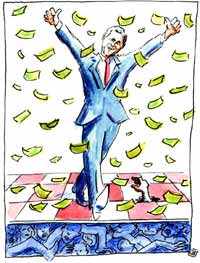
Before today's class, I viewed minimum wage as a good plan in helping those who are impoverished. I thought that all minimum wage did was make sure business owners were taking care of their workers. I looked on the internet and found this article on minimum wage. The author talks about how Congress is discussing raising the minimum wage by $1.50. The author says that most unions and liberal anti-poverty organizations are for this change. The author presents the opposing side being mostly business communities and conservatives. He also quickly shows that little evidence has been found that an increase in minimum wage makes unemployment rates rise.
I thought this article highlighted a couple important things to the reader. First of all, it is very clear where the author stands on the idea of raising minimum wage because he takes very little time to show the negative side to this $1.50 raise. He also stereotypes those opposed as "conservatives" and "business communities," making the opposing side look as if they are afraid of change or looking out for the business first. The author also says that "minimum wage are generally supported by unions and liberal anti-poverty organizations." This makes the reader think well the unions and anti-poverty people are for it so it must be good. I would be really interested to see the figures on who supports a raise and who doesn't.
There is also no suggestions for an alternative plan. I think that articles like this are what makes people not think about the economics of a situation. The economics are clearly not well represented. If this raise to the minimum wage does happen I have a feeling many people will be confused by the reverse affect on the market.
Thursday, February 23, 2006
US Figure Skater, Sasha Cohen, Fails to Grab Gold
The women’s figure skating Olympic competition was finished up tonight. It had an unpredictable end with an unexpected Japanese skater, Shizuka Arakawa, grabbing the gold medal. Both of the top contenders, Sasha Cohen from the United States and Irina Slutskaya from Russia both failed to come through in their long program performance. Sasha Cohen was in first after the short program over Irina Slutskava by just a slight amount. The gold winner, Arakawa, ended up beating Sasha Cohen, the silver medalist, by eight points. The article says this about Sasha Cohen: “The successor to Michelle Kwan as national champion has all the makings of a superstar, but she can’t break through when the stakes are highest.” She failed in the 2003 and 2004 national championships, the 2004 world competition, and the Salt Lake City Olympics to take first place. Some athletes might get discouraged from having so many chances and never being able to pull through. I do not believe that Sasha Cohen should not look back on these negative experiences. I think that her missed chances to claim a first place or gold medal could be viewed in the same way as sunk costs. They are all in the past and there is nothing that Sasha can do about it. If she decides to enter more major competitions she should enter without any hesitation and forget about her previous failed opportunities.
7 Efficient Habits
This article (which I am sorry if you cannot read the whole thing) gives a lot of great advice! The article is by Andrew Reese, a Supply and Demand Chain Executive, who interviewed a man named Jim Tompkins. Tompkins is the CEO and founder of Tompkins Associates, which is a consultancy and systems integrator. He has helped companies for over thirty years to achieve the most efficient supply chains.
Tompkins' seven efficient habits starts out with communication. He suggests that everyone within your company, in all departments, should understand what supply chain means, what the objectives are, and the "who, what, why, and where." "There should be no surprises as to what you're trying to accomplish," states Tompkins. The second suggestion he has is benchmark. This means you need to have a "framework" to base your strengths and weaknesses off of. To do this, you need to look at your competitors and what your industry is doing. Tompkins says to ask, "What the best-in-class companies are doing." Third on the efficient habit list is assess and partner. This is where you identify which areas to improve. When your company is up to par, then you are, "partnering to do visibility," as Tompkins says. Fourth habit is prioritize. Here you need to identify specific processes that you need to improve, but it is not as easy as it sounds. You need to look at the processes from different points of view to understand exactly what needs to be improved. The fifth efficient habit is lead, don't just manage. Leadership majors will be pleased to hear this little fact that Tompkins threw out. He said, "What you will find is that they're about 95% management and only 5% percent leadership." To explain what Tompkins said in this section, I can only think of one thing and that is Madonna. She has reinvented herself over several decades and young boys are still hot for her. That is leadership in Tompkins' eyes; reinventing yourself when you are number one so that you do not just disappear after your hype is gone. The sixth habit is add value by focusing on core competencies. This mean that you need to focus on what the customer values, which gives you the market position. The seventh and last habit is to continuously improve. Tompkins explains this step very plainly, "Step 7 would be, return to Step 1 and do it again." He adds that you must do each step more in depth to truly succeed.
Along with the list of the seven efficient habits, Reese put in a selection from a survey. It is the seven deadly sins of supply and demand chain enablement. These are the seven sins:
1. Failing to manage and sustain the adoption of the new technology
2. Enabling bad processes
3. Setting unrealistic goals
4. Trying to enable everything at once
5. Failing to involve supply chain partners in the implementation process
6. Believing in the infallibility of systems
7. Failing to enable the supply chain
All of these bonuses and minuses of the supply chain break down to changes in technology and resources. Wow, my mom was wrong. Economics isn't fiction after all.
Tompkins' seven efficient habits starts out with communication. He suggests that everyone within your company, in all departments, should understand what supply chain means, what the objectives are, and the "who, what, why, and where." "There should be no surprises as to what you're trying to accomplish," states Tompkins. The second suggestion he has is benchmark. This means you need to have a "framework" to base your strengths and weaknesses off of. To do this, you need to look at your competitors and what your industry is doing. Tompkins says to ask, "What the best-in-class companies are doing." Third on the efficient habit list is assess and partner. This is where you identify which areas to improve. When your company is up to par, then you are, "partnering to do visibility," as Tompkins says. Fourth habit is prioritize. Here you need to identify specific processes that you need to improve, but it is not as easy as it sounds. You need to look at the processes from different points of view to understand exactly what needs to be improved. The fifth efficient habit is lead, don't just manage. Leadership majors will be pleased to hear this little fact that Tompkins threw out. He said, "What you will find is that they're about 95% management and only 5% percent leadership." To explain what Tompkins said in this section, I can only think of one thing and that is Madonna. She has reinvented herself over several decades and young boys are still hot for her. That is leadership in Tompkins' eyes; reinventing yourself when you are number one so that you do not just disappear after your hype is gone. The sixth habit is add value by focusing on core competencies. This mean that you need to focus on what the customer values, which gives you the market position. The seventh and last habit is to continuously improve. Tompkins explains this step very plainly, "Step 7 would be, return to Step 1 and do it again." He adds that you must do each step more in depth to truly succeed.
Along with the list of the seven efficient habits, Reese put in a selection from a survey. It is the seven deadly sins of supply and demand chain enablement. These are the seven sins:
1. Failing to manage and sustain the adoption of the new technology
2. Enabling bad processes
3. Setting unrealistic goals
4. Trying to enable everything at once
5. Failing to involve supply chain partners in the implementation process
6. Believing in the infallibility of systems
7. Failing to enable the supply chain
All of these bonuses and minuses of the supply chain break down to changes in technology and resources. Wow, my mom was wrong. Economics isn't fiction after all.
Monday, February 20, 2006
McDonald's: not just burgers and fries anymore
Everyone is familiar with the Golden Arches. Everyone knows exactly what they stand for. McDonald’s, the largest fast-food chain in the world, is known for fast food that is inexpensively priced. Well, over the past few years, purveyors of McDonald’s food have begun to witness a change. McDonald’s suffered its first-ever quarterly loss in 2003, the first quarterly loss since the company went public in 1965. Now, McDonald’s is beginning to target a new audience with new healthier food choices. You can purchase a California Cobb salad for $4.50 or a grilled chicken club sandwich for $3.89. With an increase in price, you might think that there would be a decrease in demand and overall consumption of McDonald’s food. However, we have seen just the opposite. McDonald’s saw the average check total increase by 5% to about $5. The company’s annual revenue has grown from $17.1 billion in 2003, to $20.5 billion in 2005. So why is McDonald’s seeing such growth? There are many factors, one may be good timing. More Americans are becoming increasingly health conscience and thus are looking for healthier food choices. The salads, along with white-meat chicken at McDonald’s seem to provide that healthier alternative to a Big Mac and fries. So even though competitor prices or substitutes, such as Wendy’s or Burger King remain low, McDonald’s is still raking in the profits.
Thursday, February 16, 2006
Don’t Turn Right Here!
The excitement I had built up for the opening season for NASCAR has disappeared, faster than Jeff Gordan going around a quarter of a mile track. If you planned on tuning in to watch the Daytona 500 for the intensive driving don’t bother. Tony Stewart, who won the Nextel Cup championship last year, is “crying” because he thinks the “bumping and banging” is out of control. He failed to mention that last year he used this method to win a couple races. NASCAR agreed with Tony and Nextel Cup officials said they would be policing bump drafting. I’d hate to be the official who tells Dale Earnhardt, Jr., who might be in third or fourth at the time, has fresh tires, and only having fifteen laps to go that he’s been penalized for bump drafting in a wolf pack of cars just to gain positioning. Nextel Cup officials say that the penalty could range from driving through the pits to being parked. I guess the officials forgot what racing was. I remember what the crew chief for the movie “Days of Thunder” said. Cole Trickle’s crew chief said, “Rubbing is racing.” This new ruling is not going to enhance the excitement of racing. If this rule sticks the demand for a ticket to watch dirty racing is going to fall. The opportunity cost for the extra safety of Nextel’s driver will be a decrease in the fan base. Do you agree that if NASCAR imposes this rule the demand to watch races live or on television will decrease? Also, if they find out that this rule causes revenue to decline will they get rid of this rule before they lose sponsorships?
PRESIDENT PORTRAYS SOCIAL SECURITY SHORTFALL AS ENORMOUS,
The Bush adminitration, along with the currrent Social security Administration, have claimed that S.S. will face a shortfall by over $3 trillion within the next 75 years. And on top of that, projections for Medicare shortfall are as high as $68 trillion. Know there is no dought that we could have a S.S. and/or Medicare crises on hand in the distant future. But are the numbers that the administration released accurate. S.S.A. Claims that expenditures will overtake income in the year 2018. More plainly said in the year 2018 Social security will go bank-rupt. With the baby boomers reaching the age of retirement S.S. is faced with the situation of paying benefits to the massive retiring baby boomer generation while still keeping enough in the trust fund to account for those 20 Years old or younger. Now, I want to bring into prospective how the number 11.1 trillion came into play. You have most likely heard that S.S. expects a $11.1 trillion shortfall over the year infinity. First off, if it's over infinity years we simply have have to put back $1 every year over the next 11,100,000,000,000 years and the problem is solved. Seriously, even I can afford an extra $1 a year. So, according to what the S.S.A. and Bush administration has said we really don't have a problem at all (not to mention the $11.1 trillion deficit was derived from the fact that the average person will live to be 150 years old and spending about 80 years in retirement). Will Social security have enough money in the future? S.S. has survived WWI, WWII, The Cold War, Iraq (both times), The Great Depression, Vietnam, Korea, Watergate, and so on. My point is, social security has with-stood the test of time, in my opinion it's the most successful bill ever passed in America (singed into action by FDR on 8-14-1935). I'm not suggesting to change social security (or Medicare), I just want want to point out the fact that if we go by what we have been told I don't see any immediate threat to social security. Even thou I don't like higher tax rates, it would be an easy fix to the problem. Bush, however, fills that privatizing Social security is the answer to our problems. Lets say you work for 15 years for the same company, then all of a sudden it moves offshores; now you're stuck with a job at Burger King, how good will your retirement be if you can't even afford to pay money into a private account. Private accounts may work in some situations, but I ask what do you do if your private investment fails?
Chrysler Offers Dealers Cash to Take Cars
Chrysler recently offered $1,000 for every car they sell over the next two months if the dealer doesn’t cut its March vehicle order and accepts cars from the automakers bank of overbuilds. Chrysler is offering this to dealers due to sluggish sales of pickup trucks and SUV’s. There are costs and benefits for both the dealers and the Chrysler corporation. Although Chrysler’s offer will cost a thousand extra dollars for each car, they are concerned about their image on Wall Street if they were to stop production at the plants. Essentially, Chrysler would be “saving face” if they were to keep the production up, which is the benefit of this extra $1,000. For the dealers, with interest rates rising it is costing them more to hold inventory and this cuts into their profits. The obvious benefit would be the extra $1,000 on each car the specific dealer accepts. This is a prime example of how businesses, large and small, weigh the costs and benefits of all of their decisions.
Wednesday, February 15, 2006
NASCAR's Daytona 500
The Daytona 500 kicks off this Sunday (Febuary 18th, 2006) afternoon, and NBC has reported that there will be about 18 million home viewers. NBC is hoping to set a new high, and has heavily promoted the race. There are a few major companies, such as, Coke and Pepsi; Lowe's and Home Depot; Chevy, Ford and Dodge; UPS and FedEx, all fighting for a 30 second slot worth an estimated $425,000. Do you think this slot is worth the money? Read the article, and comment about the idea of airing NASCAR's first Black History Month ad. Is it a good idea to break up the Olympics with NASCAR's Daytona 500? Do you think the interruption of the Daytona 500 is going to hurt/help either the Olympics or NASCAR's ratings? People may not tune into the Olympics after the long day of car racing, on the other hand, people may watch the Olympics after.
Cleveland Browns to make splash in free agency?
With possible free agent acquisitions such as Defensive End John Abraham and Shaun Alexander, perhaps even Lavar Arrington, the Browns and their 25 million expendable dollars figure to make themselves into a contender via free agency. However, it can be argued that spending loads of money in the free agent market will ultimately kill their bottom line. They have sold out ever game since they came back to Cleveland in 1999, and attendance has nowhere to go but down. This would seem to imply that the Browns owners are more committed to winning than to the bottom line. My question is that do you feel that spending this extra money will affect the bottom line negatively or positively. I maintain that it will positively affect them because of all the playoff compensation that seems iminent.
New Roof: Worthy of Taxes?
The Cleveland Browns' stadium is under consideration for the addition of a $90 million retractable roof. How is the city planning to pay for this? Well, the same way they paid for the stadium in the first place: taxes on cigarettes and alcohol. This "sin tax" is being used on something that is as seemingly trivial as a retractable roof for an already new stadium; it seems that perhaps better use of these funds could be found. However, these planners do have the economic well-being of the city in mind. They feel that this addition to the stadium would put them in a position to host a Superbowl in the next 10 years. This would be a tremendous boost to the local economy, such as can be seen in Detroit this year. However, one-time events cannot solve deep-rooted economic difficulties. Do you think that the new roof is worth the $90 million in tax money, or should these funds be used in other ways? The information for this post can be found at: http://www.newsnet5.com/news/7056180/detail.html.
wage increases
Here is one thing everyone can be happy to hear, higher wages! In this CNN article economists are now predicting a raise in the average wage rate. The unemployment rate fell to 4.7 percent this Friday, the lowest level since July 2001, just before the Sept. 11 terrorist attacks. Now 65% of US workers say that they are considering looking for a new job. Economists are also saying that with the switch in job people can expect a 10% increase as part of the move. With the increase in wages companies are now worried about employees leaving. Forcing more company’s to be more generous with raises, and bonuses. This is a clear shift in demand. The market for labor has a higher quantity and a higher price do to this shift. The worry on Wall Street is that the raise in labor costs will lead to a pick up in inflation. What we think is a great wage increase is not as great as we think. What are some things the government can do to prepare for the pick up in inflation? Or is this problem just inevitable? Will it work it’s self out?
The Corporate Olympics
The Twentieth Winter Olympiad is underway in Turin, Italy, and while the athletes and spectators from around the world are competing at their highest levels, the organizers of the event are breathing a larger sigh of relief than any of the athletes who have won a gold medal. Turin's olympic organizers are celebrating their getting the 2006 winter games under budget, though it seemed to be a struggle to the last day, with organizers not knowing the day before the opening ceremonies if the costs would be covered.
The olympic operating budget for the Turin games is estimated at nearly one and a half billion dollars, a staggering sum, given the events last the whole of three weeks. But, how does one smallish town in Italy generate that much operating revenue to cover the costs of the games? The wonderful world of corporate sponsorship and television broadcast rights, that's where.
Of the 1.5 billion in costs to operate the games, 40 percent will come from broadcast rights paid for by NBC and its enclave of international broadcast partners for the event. Corporate sponsors will account for 39 percent of the Turin games' revenues. As for tickets, they will account for 6 percent of revenues, half of the amount tickets accounted for in the last Winter Olympics, set in Salt Lake City.
These monies are part of major deals signed with the International Olympic Committee, some far in advance of these games. NBC, for instance, paid 3.5 billion for the rights to 5 Olympiads, starting with the 2002 Salt Lake City games and going until the 2010 Vancouver games. 11 other major multinational companies signed similar long-term deals, to the tune of $173 million over the next 2 Olympics. In addition, 4 major Italian companies, including auto manufacturer Fiat, are kicking in 50 million each, with even more coming from other companies providing cash or services to the Turin games.
And yet, even with all of this money flowing in, the budget for the games was still in a $24 million shortfall as recently as late December. Organizers struggled to meet budget, having to seek approval to sell scratch-off lottery tickets to cover some of the costs. Still, some localities around Turin will have to pick up any remaining slack that may remain even after the lottery funds come in.
With the ever increasing pressure for Olympic host countries to outdo their predecessors, the costs of the games are becoming so astronomical, people who see these staggering numbers scratch their heads in wonderment of how so much money can be sunk into the games themselves. While it would seem that countries want to build stadiums, for instance, that could be practical afterwords and not be Olympic only venues, most structures of recent Olympics have become those "white elephants" that organizers want to avoid. One such venue from the 2004 Athens games, for instance, is now used as a weekend flea market - albeit a $400 million dollar flea market.
Do the Olympics need to be such corporate festivals? Does the excess cost really make an Olympiad that much more exciting? And, do you think the mindset for countries to out-do one another will become too uneconomically feasable to support?
The olympic operating budget for the Turin games is estimated at nearly one and a half billion dollars, a staggering sum, given the events last the whole of three weeks. But, how does one smallish town in Italy generate that much operating revenue to cover the costs of the games? The wonderful world of corporate sponsorship and television broadcast rights, that's where.
Of the 1.5 billion in costs to operate the games, 40 percent will come from broadcast rights paid for by NBC and its enclave of international broadcast partners for the event. Corporate sponsors will account for 39 percent of the Turin games' revenues. As for tickets, they will account for 6 percent of revenues, half of the amount tickets accounted for in the last Winter Olympics, set in Salt Lake City.
These monies are part of major deals signed with the International Olympic Committee, some far in advance of these games. NBC, for instance, paid 3.5 billion for the rights to 5 Olympiads, starting with the 2002 Salt Lake City games and going until the 2010 Vancouver games. 11 other major multinational companies signed similar long-term deals, to the tune of $173 million over the next 2 Olympics. In addition, 4 major Italian companies, including auto manufacturer Fiat, are kicking in 50 million each, with even more coming from other companies providing cash or services to the Turin games.
And yet, even with all of this money flowing in, the budget for the games was still in a $24 million shortfall as recently as late December. Organizers struggled to meet budget, having to seek approval to sell scratch-off lottery tickets to cover some of the costs. Still, some localities around Turin will have to pick up any remaining slack that may remain even after the lottery funds come in.
With the ever increasing pressure for Olympic host countries to outdo their predecessors, the costs of the games are becoming so astronomical, people who see these staggering numbers scratch their heads in wonderment of how so much money can be sunk into the games themselves. While it would seem that countries want to build stadiums, for instance, that could be practical afterwords and not be Olympic only venues, most structures of recent Olympics have become those "white elephants" that organizers want to avoid. One such venue from the 2004 Athens games, for instance, is now used as a weekend flea market - albeit a $400 million dollar flea market.
Do the Olympics need to be such corporate festivals? Does the excess cost really make an Olympiad that much more exciting? And, do you think the mindset for countries to out-do one another will become too uneconomically feasable to support?
Johnny Damon a Yankee: good thing for the Red Sox?
As many baseball followers know, Johnny Damon joined the dark side this year for $52 million dollars over 4 years. The Red Sox best offer was 4 years $40 million (the same offer they gave Jason Varitek and Edgar Renteria the previous season). The Red Sox believe Johnny Damon was not "worth" $52 million dollars. I ask the Red Sox to define "worth". Is Johnny Damon not worth $3 million more a year? Did the Yankees pay too much for him? Was Johnny selfish? The whole "worth" thing gets to me. Damon said he loved the fans of Boston (rightfully so they created him). He was THE MAN in Boston. Damon is arguably one of the best leadoff hitters in baseball, a major threat to any opposing pitcher, and a great guy in the clubhouse.
The Red Sox just have a poor excuse. According to one of Dr. D's lectures, ticket prices influence salaries. The Red Sox have the highest demand from fans of any team in sports. The Sox sell out every game, have a season ticket demand larger than anything anyone can imagine, and their prices are through the roof. The Red Sox fans are willing to pay extra to go to games to see the players, the rivalries, and championships. Johnny Damon brought in a large amount of revenue to the Red Sox. His jersey sales were among the leagues highest. Now all that revenue goes to New York because they thought Damon was worth more.
Ok, the "worth" part of my blog. There were two big name leadoff hitters that were free agents this winter. Rafael Furcal and Johnny Damon. Damon is by far more productive than Furcal and has the stats to prove it. Furcal signed for 3 years $39 million one month before Damon got his contract. To Damon, he was "worth" more than Furcal. Damon wanted a salary equivalent (or better) than Furcal. Is Damon worth $52 million? Is Furcal worth $39 million? What am I worth? Who decides my value? Does the Yankees paying Damon $52 million make him worth $52 million? I would say yes because he getting paid that. The Red Sox do not think he is worth $52 million and chose not to pay him that. For that they lose. What does Johnny Damon being on the Yankees do to Red Sox revenues? Probably increase them because all the fans that bought Damon jersey last year will go out and spend more money on Damon Haters shirts and Coco Crisp jerseys. The money the Red Sox saved by trading for Crisp (who makes $3.75 million per year) allows them to go after other players. What it comes down to is that Johnny Damon IS worth $52 million because someone paid him that amount, just not the Red Sox. The Red Sox will still sell out, still raise ticket prices, and still have a list of over 1,000 people waiting for season tickets.
The Red Sox just have a poor excuse. According to one of Dr. D's lectures, ticket prices influence salaries. The Red Sox have the highest demand from fans of any team in sports. The Sox sell out every game, have a season ticket demand larger than anything anyone can imagine, and their prices are through the roof. The Red Sox fans are willing to pay extra to go to games to see the players, the rivalries, and championships. Johnny Damon brought in a large amount of revenue to the Red Sox. His jersey sales were among the leagues highest. Now all that revenue goes to New York because they thought Damon was worth more.
Ok, the "worth" part of my blog. There were two big name leadoff hitters that were free agents this winter. Rafael Furcal and Johnny Damon. Damon is by far more productive than Furcal and has the stats to prove it. Furcal signed for 3 years $39 million one month before Damon got his contract. To Damon, he was "worth" more than Furcal. Damon wanted a salary equivalent (or better) than Furcal. Is Damon worth $52 million? Is Furcal worth $39 million? What am I worth? Who decides my value? Does the Yankees paying Damon $52 million make him worth $52 million? I would say yes because he getting paid that. The Red Sox do not think he is worth $52 million and chose not to pay him that. For that they lose. What does Johnny Damon being on the Yankees do to Red Sox revenues? Probably increase them because all the fans that bought Damon jersey last year will go out and spend more money on Damon Haters shirts and Coco Crisp jerseys. The money the Red Sox saved by trading for Crisp (who makes $3.75 million per year) allows them to go after other players. What it comes down to is that Johnny Damon IS worth $52 million because someone paid him that amount, just not the Red Sox. The Red Sox will still sell out, still raise ticket prices, and still have a list of over 1,000 people waiting for season tickets.
How big will scaled-down Mardi Gras celebration be?
This article speaks of the devastion Hurricane Katrina had on New Orleans and how, if at all, they will be able to bounce back and be prepared for the Mardi Gras celebration this year. Mardi Gras has always been a huge ordeal in New Orleans that cultivated over $1 billion visitors each year for its 12+ days of celebration. Sadly enough, after the devastation of Katrina, the town is unsure what to expect in the shortened celebration of 8 days. A problem seemed to be presented is the vacancy of hotel rooms, since many are occupied by those families made homeless by the hurricane, as well as recovery workers. Many townspeople and officials say they honestly do not know what to expect, but they are certain that although this may not be the largest Mardi Gras ever it will definately be the most emotional. The city is hoping for a decent crowd, because the larger the crowd the more income the city will get to continue it's fight towards restoration.
Tuesday, February 14, 2006
Toronto Could See Sports Monopoly
In 1998, the question was posed, "Can whom ever owns the Skydome in Toronto Canada develop themselves into a monopoly"? This questine in 1998 can be asked today however with a little more knowledge. In 1998 the Skydome and those who owned it were losing money and bacame broke in a corporate sense. In the article they compare the Expos and the BlueJays. As one might know now, there is no longer a Montreal Expos baseball team, however there are still the lonesome BlueJays in the midst of a country with enough fans to possibly monopolize. My question is that, can the new owners of the Skydome pull off a giant monopoly of sports in Canada? Turner, the media company whom already owns the Atlanta Braves already has one synergy or owns a team plus the media coverage, may possibly interested in the purchase of the Skydome and BlueJays. With that in mind, Let's recap. If there were a synergy with Turner and the Toronto BlueJays, being the only team in Canada, just think of the profit which could be made. The article also posses the question, "what if one person obtained the Leafs, Raptors, and BlueJays along with the concerts and what not the Skydome and Air Canada Arena hold?" The article directly states, "The area around the stadium and the arena, would become one big sports and entertainment complex. The television network would have first crack at what amounts to nearly a game a day during the calendar year." Is there a possibility for a monopoly?
Economics of MLB All-Star Game
The football season has come to an end with the Pittsburgh Steelers's victory in Super XL and many sports fans are beginning to look forward to the baseball season. In particular, the city of Pittsburgh and all Pittsburgh Pirates fans will prepare for a decent season (hopefully) and the 2006 MLB All-Star game to be played on July 11th at PNC Park. In an article I read from the Pittsburgh Post Gazzette, city officials are expecting an image boost as well as a major (and very much needed) economic boost from the game and week-long All-Star festivities. The city is currently facing a $78 million deficit and, with estimated revenue numbers from the past 2 All-Star events at $85.6 million for Houston and $50 million for Detriot, hopes to dramatically better its financial situation. However, repairs, landscaping, construction, and many other beautification projects must take place in order for the city to host a successful (or even decent) event. No doubt such projects will generate jobs, but is the city able to fork out the money without guarantee that it will break-even or profit from the game? I believe that Pittsburgh was given the most excellent oppurtunity to recover from its economic slump through the 2006 MLB All-Star week. The Pirate ball club and PNC Park will be making big bucks from the rise of season ticket holders who purchase the package just for privelleges at the All Star game and from the pricey All Star game tickets. However, most of the revenue from the game will not come directly from PNC Park or the Pirates club, but as a result of the trickle down effect. For example, many area hotels, businesses, airports, parking vendors, etc. will generate a reasonable amount of profit.
Monday, February 13, 2006
Highway Markers Honor DUI Victims
Georgia governor just passed a state law that puts up a memorial sign for all the victims of drunk driving accidents. The first one was just put up, and they are hoping others will see the signs and say "Well, there really was someone killed by a drunk driver." The signs are about the same size of a speed limit sign, and officials are trying to send a message out that is more personal. So far only eight victims' families have asked for a sign to be put up. Some families don't want a sign put up if it is a road they travel on frequently. Other roadside memorials (flowers, crosses, etc.) are becoming "garnish shrines" that can distract drivers. They are hoping the new signs will not distract other drivers and cause more accidents. State officials are just trying to get the message out that drunk driving causes many fatalities that never should happen. No one knows if the signs will really help decrease the number of fatalities, but it is worth a try.
General practioners
| This article discusses two important parts of the medical field, general practices and general practioners. In the first part of the article, it discusses how governmetn funding is used to fund general practices. This is an example of government stepping in to make sure the markets are working correctly, if they are not leaning towards equilibrium. The second part of this article discusses who general practioners rely on to get paid. The article mentions that they rely on the person sitting right in front of them. This is an example of personal decisions interacting in the market. The patient going into the doctor is seeking medical attention, while the practitioner is looking to gain money by taking care of the patient. This is also a trade-off between these two people!! |
Crime Doesn't Always Pay
After Hurricane Katrina reports of fraud and scheming were almost immediately in the news. Hundreds of people or maybe even more, driven by greed, opportunity and disaster came up with a multitude of ideas of how to get more money. Most of these reports were about how individuals attempted to get money from FEMA under false names or insurance for houses that never existed.
In contrast, a group of 49 Red Cross workers and their family members have been indicted in a scam to steal Red Cross hurricane relief funds. These people who were part of an organization based in helping people took an opportunity to help themselves. These people are charged with tapping into the system and creating fake accounts then had family members receive these.
In this case crime really has not paid off, at least for these individuals. They choose something without thinking about the marginal cost and marginal benefit. They most likely did not know how likely it was to be caught because of the individuality of this crime yet the Red Cross was offering $360 for individuals but more than $1,500 for families. This is a small fraction of the amount these individuals were most likely making in their every day lives, by working or retirement. In addition, these people are now facing not only fines but also jail time. This attempt to get rich was not rational and to this individuals not profitable.
In contrast, a group of 49 Red Cross workers and their family members have been indicted in a scam to steal Red Cross hurricane relief funds. These people who were part of an organization based in helping people took an opportunity to help themselves. These people are charged with tapping into the system and creating fake accounts then had family members receive these.
In this case crime really has not paid off, at least for these individuals. They choose something without thinking about the marginal cost and marginal benefit. They most likely did not know how likely it was to be caught because of the individuality of this crime yet the Red Cross was offering $360 for individuals but more than $1,500 for families. This is a small fraction of the amount these individuals were most likely making in their every day lives, by working or retirement. In addition, these people are now facing not only fines but also jail time. This attempt to get rich was not rational and to this individuals not profitable.
Rising Gas Prices
One of the most popular topics of conversating in the US has been Gas prices. The US experienced hikes in gas prices largely in the past because of Hurricane Katrina. It was interesting to see that the British are also experiencing a rise in gas prices. After reading this article, it makes one wonder if the increases had to do with the destruction caused by Hurricane Katrina or because of a global shortage. As the article states, Britain's reserves meet only 4% of annual demand. Perhaps we should focus more effort on new ways of fueling our cars.
VW cuts jobs
In Frankfurt Germany volkswagon said over the next four years, it plans to cut over 20,000 jobs. Inturn this willl make the company more profitable and bring ina better revenue. Although this plan looks goood from the VW perpesctive, it may not be such a good idea in the long run. These 20,000 that will lose their jobs will be forced to find work elsewhere, but what if they can't? Jobs are scace and the fact is that if some don not find jobs, then that could have a big effect on the econommy in Germany.
Air China Come into the Market
Last Friday, Air China Ltd which is the largest aircraft company planed to sell 800 million dollars count as RMB in Class A shares. Air China will collect money for new aircrafts or to develop the Operation Center in Beijing.
Air China announced that, they will use the money to expand the collection of aircrafts, which includes 20 A330-200, 15 Boeing 787 and 10 Boeing 737-800 aircraft. More than this Air China will invest the Beijing Capital Airport’s rebuild project, which needs about 7.45 million dollars.Air China would apply to come into the market on March. If they got approved Air China would be the first company that allows to issue this kind of stock since Securities Regulatory Commission suspend this on April, 2005.
As the largest recognized Airline Company, Air China plans to collect money form the stock to enlarge its business. It’s a big action for a huge company that own by state.
Air China announced that, they will use the money to expand the collection of aircrafts, which includes 20 A330-200, 15 Boeing 787 and 10 Boeing 737-800 aircraft. More than this Air China will invest the Beijing Capital Airport’s rebuild project, which needs about 7.45 million dollars.Air China would apply to come into the market on March. If they got approved Air China would be the first company that allows to issue this kind of stock since Securities Regulatory Commission suspend this on April, 2005.
As the largest recognized Airline Company, Air China plans to collect money form the stock to enlarge its business. It’s a big action for a huge company that own by state.
Considering the Possibility Curves of Costumers
There is a germen restaurant in
The restaurant does allow dogs inside the establishment, though. This raises the possibility that, lacking suitable dog free rooms, they will lose the patronage of people with allergies, and perhaps others who simply do not like dogs. In the best case scenario the restaurant would have enough room to set aside areas for dog lovers and people with young children, but it is far more likely that the restaurant exists in a building with a limited amount of property for such things.
United States cutting in on Australia's turf?
Following the destruction of Sadam's regime in
However,
2005 trade deficit hits record of $725.8B
Mainly due to a record high in importing crude oil, 2005 saw an overall record of a $725.8 billion gap between American imports and exports. The trend of an increasing trade defecit has drawn on for four consecutive years. With the trade deficit at an all-time high, one has to wonder if those in charge of foreign policies have noticed the trend at all. Economists are split over whether the gap will reach a trillion in the next few years but it seems dependent on who the next president will be. As long as we stay in the Middle East, our overseas relations will not be as great as we'd like them to be. But with recent talk of a free trade agreement with South Korea and the growth of other foreign countries, I can see how the decifit will eventually level off. However, Democrats argue that opening up free trade agreements will cause more Americans to lose their jobs, as 3 million have already suffered from unemployment since mid-2000.
I agree that the numbers are pretty alarming, but they are a little inflated due to the fact that we are importing abnormally large amounts of crude oil these days. The high price of the oil also has a significant affect on the numbers. But regardless, America needs to look more inward in regards to the economy and increase the amount of exports. I've only been in an economics class for a few weeks now and I know that there are significant gains from trade. So unless we are getting the full bang for our buck in having such a large trade deficit, something has got to give.
I agree that the numbers are pretty alarming, but they are a little inflated due to the fact that we are importing abnormally large amounts of crude oil these days. The high price of the oil also has a significant affect on the numbers. But regardless, America needs to look more inward in regards to the economy and increase the amount of exports. I've only been in an economics class for a few weeks now and I know that there are significant gains from trade. So unless we are getting the full bang for our buck in having such a large trade deficit, something has got to give.
Sunday, February 12, 2006
These days, there are visible changes in Korea
These days, there are visible changes in Korea.
Above all, “The Bank of Korea” raised its overnight call rate by a quarter percentage point to the highest level in three years. Some experts said that the truth is hardly surprising, call rates are increasing. As well as, some economists expect the Bank of Korea to increase the rate at least once more this year. The central-bank governor, Park Seung, also said that at 4% the rate still supports economic growth but is "very close to being neutral. He is convinced that he is right.
But I think there is another problem in the situation. At first, the bank's move came despite concern over the rising value of the nation's currency and despite fierce political pressure from the government. A stronger won hurts exports, a traditional engine of economic growth because it makes South Korean goods more expensive abroad. It could be a deathblow to Korea’s foreign trade. However there are a lot of South Korean companies, especially small traders, concerned about the won's gains. Samsung Electronics, Hyundai Motors and other corporate giants have hedged their currency bets,
Speaking to reporters after the rate increase, Park, the central bank governor, said a rise was needed to fight inflationary pressure since South Korea's economy is recovering faster than expected because of strong private consumption. Likewise there are many things to figure out. The Bank of Korea has to do something to solve the problem.
Above all, “The Bank of Korea” raised its overnight call rate by a quarter percentage point to the highest level in three years. Some experts said that the truth is hardly surprising, call rates are increasing. As well as, some economists expect the Bank of Korea to increase the rate at least once more this year. The central-bank governor, Park Seung, also said that at 4% the rate still supports economic growth but is "very close to being neutral. He is convinced that he is right.
But I think there is another problem in the situation. At first, the bank's move came despite concern over the rising value of the nation's currency and despite fierce political pressure from the government. A stronger won hurts exports, a traditional engine of economic growth because it makes South Korean goods more expensive abroad. It could be a deathblow to Korea’s foreign trade. However there are a lot of South Korean companies, especially small traders, concerned about the won's gains. Samsung Electronics, Hyundai Motors and other corporate giants have hedged their currency bets,
Speaking to reporters after the rate increase, Park, the central bank governor, said a rise was needed to fight inflationary pressure since South Korea's economy is recovering faster than expected because of strong private consumption. Likewise there are many things to figure out. The Bank of Korea has to do something to solve the problem.
Volkswagon Layoffs bound to reach 20,000 workers
In this article, Volkswagon is going to get rid of 20,000 workers to continue with a higher technology and make of cars. Because of this huge amount of layoffs, the economy will need to be prepared to have more availability of jobs for these 20,000 to make it in the world. I wonder if the workers that know they will not be there anymore will stay there until they are told to leave, or if they will just leave Volkswagon in a hunch and leave without their work complete?
Mining Fines Among Smallest
MariettaEcon
During the 2004 Super Bowl Janet Jackson had a wardrobe malfunction in which her breast was exposed. As everyone knows there was a large fine of $550,000 for the mishap. When it comes to being fined, it is common sense that a mishap resulting in death should be more consequential than a mishap resulting in indecent exposure. Although this does appear to be common sense, it is not. In 2001 13 miners were killed in an Alabama mine and the consequence for the terrible malfunction resulted in only a $3000 fine. Though the fine did begin at a price of 435,000 dollars, it was reduced to $3000 because the problem was fixed. As a result, many investigations have been made to strengthen the consequence of low worker safety at mines. A minimum fine of $10,000 has been proposed but if we are going to charge hundreds of thousands of dollars over a wardrobe mistake then we need to rethink what we are focusing on because death is obviously more important!
During the 2004 Super Bowl Janet Jackson had a wardrobe malfunction in which her breast was exposed. As everyone knows there was a large fine of $550,000 for the mishap. When it comes to being fined, it is common sense that a mishap resulting in death should be more consequential than a mishap resulting in indecent exposure. Although this does appear to be common sense, it is not. In 2001 13 miners were killed in an Alabama mine and the consequence for the terrible malfunction resulted in only a $3000 fine. Though the fine did begin at a price of 435,000 dollars, it was reduced to $3000 because the problem was fixed. As a result, many investigations have been made to strengthen the consequence of low worker safety at mines. A minimum fine of $10,000 has been proposed but if we are going to charge hundreds of thousands of dollars over a wardrobe mistake then we need to rethink what we are focusing on because death is obviously more important!
Delta cancels East Coast Shuttle Sunday
Delta Airlines has canceled flights to the eastern seaboard because of snow. It has not been a bad winter as far as it goes for this year (meaning a steady turn of flights). The airline is allowing its customers that have been delayed to schedule flights that will not have any incurring costs. This is a sunk cost to the passangers of Delta Airlines. The passangers have already invested time and money for the trip previous to this event. By gaining the ability to get to their destination in an aternate way, the lost time is a sunk cost. Delta hopes to capture some loyality with those delayed because they are able to satisfy their customers with not charging they to go an alternate route. They feel they can do this because of their ability to accomeadate the customer. Also they feel that they can capture some main frame clients through the big city locations. If you are able to serve a client then you have served your target market successfully. Taking on some additional costs to effectively serve is a must in order to stay strong in the Airline industry today.
What do you think this will do to Delta Airlines? Are the costs, taken on due to the delays, sunk costs for passangers, why or why not? What effect might this have on Delta Airline's PPF? If you were to make a decision for Delta on how to fix this situation, what areas might you be able to effectively use your resources?
What do you think this will do to Delta Airlines? Are the costs, taken on due to the delays, sunk costs for passangers, why or why not? What effect might this have on Delta Airline's PPF? If you were to make a decision for Delta on how to fix this situation, what areas might you be able to effectively use your resources?
Is mariage worth anything?
Many people have said being married is a pain. However, researchers have said that marriage can actually save people money. If someone lives alone, they buy groceries for 1 person, however, usually the servings are enough to feed at least 2. When a married couple goes to buy groceries, they spend the same about. But they are both eating. It is also cheaper to house a couple than 1 person.
Rent!
New York City has been known as an ideal place to live. It has plenty of night clubs, tons of shops with designer labels, some of the grandest landmarks in the world. However, nowadays, all that luxury comes at a high price. Rents are increasing, renters incomes are going down, and the number of rent-controlled units is shrinking as elderly tenants die or just leave them.
According to the most recent Housing and Vacancy survey, the number of apartments for working-class and poor New Yorkers has gone down by at least 20 percent since 1993. Since that year as well, there are over 112,000 fewer apartments in New York City that rent for less than $500 a month. The median rent for all units in NYC has actually increased by 18 percent to around $593. Victor Bach, a housing policy researcher for the Community Service Society insists that something must be done to prevent low-income people from being evicted due to rent inflation.
Many people dream big of moving to New York City and making it big. Everyone knows that if you can make it there, then you can make it anywhere. However, all must also remember that this city is expensive, not cheap. It does always sound exciting to live in the Big Apple, but if you can't find the money to support yourself and pay rent, then you might run into serious problems. You must always consider how your marginal benefits of living in the big city measure up against the marginal costs of living in an expensive city as well. My advice would be to take a good look at the musical Rent and see how tough it is for some of the characters who hadn't even paid a year's worth of rent at the start of the show. How much would living in NYC really cost someone and would it really be worth it?
According to the most recent Housing and Vacancy survey, the number of apartments for working-class and poor New Yorkers has gone down by at least 20 percent since 1993. Since that year as well, there are over 112,000 fewer apartments in New York City that rent for less than $500 a month. The median rent for all units in NYC has actually increased by 18 percent to around $593. Victor Bach, a housing policy researcher for the Community Service Society insists that something must be done to prevent low-income people from being evicted due to rent inflation.
Many people dream big of moving to New York City and making it big. Everyone knows that if you can make it there, then you can make it anywhere. However, all must also remember that this city is expensive, not cheap. It does always sound exciting to live in the Big Apple, but if you can't find the money to support yourself and pay rent, then you might run into serious problems. You must always consider how your marginal benefits of living in the big city measure up against the marginal costs of living in an expensive city as well. My advice would be to take a good look at the musical Rent and see how tough it is for some of the characters who hadn't even paid a year's worth of rent at the start of the show. How much would living in NYC really cost someone and would it really be worth it?
Mardi Gras Returns to the Big Easy
The Mardi Gras celebration returning to New Orleans this year should turn into a huge economic boost for the area. It is awesome that residents and local organizations are poking fun at the situation, even if it is at the expense of some, because this will not only lighten spirits but also attract visitors to the area. Had the celebration been put off this year this huge amount of profit would have been lost. The turn out will undoubtedly be less than normal, but without this boost to the Big Easy's economy revitalization may have taken a much longer time.
Big sponsors also hoping to win gold in Turin
This winter's Olympic Games are not only for spectator's delight, but also for the financial benefit of corresponding sponsors. Aside from the NFL, the Olympics are the most watched sporting event on American TV. Top sponsors for the Olympics include Visa, McDonalds, Coca-Cola, Panasonic, Samsung. Companies like those choose the Olympics to sponsor for the obvious reason that so many Americans will be watching the games. They realize that since it is the second most watched sporting event, they will get much return on their products and have their product be widely broadcast. Since it is such a low per-unit cost of marketing to the audience, it is sensible for the sponsors to use this as an outlet to capitalize on this advertising strategy. The commericials and other means of advertising these companies use during the Olympics might be bigger than usual, and more expensive, but the oppurtunity cost of the income they will recieve on their products after the ads go out exceeds what they spend on making the ads. So just like the Super Bowl and the infamous commercials that go out every year, the Olympics are a sure way of getting a message across to a nation-wide audience.
Great Firewall of China
In order for the search engine company Google to be able to have access to China, they had to agree to censor their website. Since China is communist they censor the world wide web from their people. Supposedly, the company said that censoring their search results conlficts with their mission statement. Because of "selling out" to China, Googles stocks are falling. This goes to show that companies will do anything if it means making money for them as the article says; "It became a little clearer last week that there can be only one kind of company: the kind that makes money." In my opinion I dont think it is right that China censors their internet in the first place, but, I dont live in a communist country where you can't express your opinion. Google basically just sold out to censorship for money. Everything in the whole world revolves around money, whether you want to admit it or not. I think it was best said, when talking about the world and money, by Kanye West: "The people highest up got the lowest self esteem. The prettiest people do the ugliest things. For the road to riches and diamond rings."
The more trade the better?
There are current talks between the U.S. and South Korea for a free trade relationship. This possible trade relationship could do wonders for both the U.S. and South Korea economiclly. I'm sure that there will many who are against the free trade expansion by the U.S., especially to a country that will increase U.S. exports to $19 billion and imports from Korea by $10 billion. Having said this I'm going to take a side here and its with America. The more money that America gains is someway going to benefit most Americans. If two countries producing different goods, and both have consumption needs then why not trade to make each countries economy more efficient. Isn't efficiency an important factor in a stable economy?
Ban on Smoking
Over the summer and during breaks, I work at a highly-stressful job. Many of the people I work with spend a lot of their break time in the designate "smoking gazebo." I don't smoke, but I will be more than happy to spend time with these people. Am I afraid of getting lung cancer? No. Will secondhand smoke hurt me? I doubt it. If you can prove to me that people die of secondhand smoke inhalation, be my guest. First, tell me how you'll do it. No answer for me? I'm not surprised.
People have smoked for years. In my parents's day, you could smoke just about anywhere- even in the movie theaters. Nowadays, you can't smoke in restaurants, hotels, etc. And many non-smokers want to take away every place that people are allowed to smoke. Why? Because they claim smoking kills. Not necessarily the smoker, but the people nearby. Again, prove it.
People spend a lot of money on cigarettes- a pack these days costs about $4 on average. And yet, people continue to smoke. From an economic point of view, this is good. If people want to smoke, they'll pay, which will in turn boost the economy; maybe not a lot, but a boost nonetheless. Smoking is becoming too controlled. If a person walks by me on the street with a cigarette, I promise not to cringe or cough or cast a dirty look.
Smoking isn't the worst thing in this world- anti-smokers need to find something else to whine about.
People have smoked for years. In my parents's day, you could smoke just about anywhere- even in the movie theaters. Nowadays, you can't smoke in restaurants, hotels, etc. And many non-smokers want to take away every place that people are allowed to smoke. Why? Because they claim smoking kills. Not necessarily the smoker, but the people nearby. Again, prove it.
People spend a lot of money on cigarettes- a pack these days costs about $4 on average. And yet, people continue to smoke. From an economic point of view, this is good. If people want to smoke, they'll pay, which will in turn boost the economy; maybe not a lot, but a boost nonetheless. Smoking is becoming too controlled. If a person walks by me on the street with a cigarette, I promise not to cringe or cough or cast a dirty look.
Smoking isn't the worst thing in this world- anti-smokers need to find something else to whine about.
strikiing pilots
The article is on the the pilots of Delta airlines. Delta inorder to prevent brankrupty has told its pilots that an 19 percent decrease in their pay is mandatory. This inturn sparked an imeadiate reaction from the pilots, and led them to go on strike. Obviously, this will have a huge impact on the Delta airlines industry. If the pilots and Delta do not reach an agreement, there is a good chance that Delta may no longer be a business.
Was it really worth it?
With the War in Iraq continuing to cost the American Public more and more it rises the question was it really worth it. the link shows where the money could have gone. and what benefits have we seen shelling out all this money?
What is the Cost of Fast Food?
With information like this constantly being released by the fast food industry in America, it seems quite befuddling as to why the industry as a whole does so well. This is just one more item to tally into the cost column regarding the consumption of fast food. Health problems are a growing topic regarding smoking.......but few people ever consider that same topic when consuming fast food. People nation wide know that fast food is unhealthy...yet it seems that the idea of exactly how unhealthy isn't stressed much. If we as a nation can consider health reasons a large enough cost to logically form a negative opinion regarding smoking, why is this minimized with fast food? Fast food provides many of the same benefits such as satisfaction, and a few others such as sustenance. But are Americans putting enough emphasis on health when weighing the costs and benefits of fast food?
Ohio Gift Card Legislation
Just a few years ago gift cards became one of the most popular gifts to give someone. However, they have recently come under fire with stores having expirations, declining balance or fees. Thankfully our state government is taking action against these stores and joining other states that are putting restrictions on gift cards. The Ohio Senate passed the bill that would no longer allow stores to have a declining balance, expirations on their gift cards, or fees and if they do to clearly advertise these facts. Currently the House is working to see which gift cards will be covered under this new bill.
As consumer, I loved the idea of gift cards; you did not have to worry about going back and exchanging gifts with in a certain time period (30 days) and not to mention how much time it saved for the gift giver. This first came to my attention when I went to American eagle with over $200 in gift cards, only to learn that I had to use them (gift cards) with in two years of their purchase date and face a declining balance. I had received these on several occasions, but because I went to a boarding school I did not have an interest in spending money until college. Had I known, I would have spent them when I received them instead of waiting. Now I am with out $200 worth of clothing and very frustrated. Also one other thing that arouse with my Christmas gift cards is some companies (American express) is charging activation fees just to use the card, keep in mind that is a minimum charge. My feeling is that the store already has the money let me send it when ever I want. If they do have an expiration date, declining balance, or fees they should clearly advertise this and not take money away from what would have been their customers.
As consumer, I loved the idea of gift cards; you did not have to worry about going back and exchanging gifts with in a certain time period (30 days) and not to mention how much time it saved for the gift giver. This first came to my attention when I went to American eagle with over $200 in gift cards, only to learn that I had to use them (gift cards) with in two years of their purchase date and face a declining balance. I had received these on several occasions, but because I went to a boarding school I did not have an interest in spending money until college. Had I known, I would have spent them when I received them instead of waiting. Now I am with out $200 worth of clothing and very frustrated. Also one other thing that arouse with my Christmas gift cards is some companies (American express) is charging activation fees just to use the card, keep in mind that is a minimum charge. My feeling is that the store already has the money let me send it when ever I want. If they do have an expiration date, declining balance, or fees they should clearly advertise this and not take money away from what would have been their customers.
High-Class Tourism
Honolulu, Hawaii has became overcrowded with tourists. In the past year the island had a little over seven million visitors come spending billions of dollars. Of course this is good for the economy, but marketers are worried that their 'aloha' image will suffer. They are trying to target 'active-seeking' travelers and make the island more exclusive. The type of people who have no money problems.
All of the inns are constantly booked, and are starting to be more selective in the types of guests they receive. Along with hotel space, available plane seating and perserving natural resources are issues that dictate capacity. With the island overcrowding, marketers are worried that the product will suffer and they will become like any other sand destination.
Is making the island more exclusive worth the opportunity cost? Is the marginal benefit of a less crowded beach worth the cost of lost customers? Is it fair to only target the "best" customers, leaving it unaffordable to others?
All of the inns are constantly booked, and are starting to be more selective in the types of guests they receive. Along with hotel space, available plane seating and perserving natural resources are issues that dictate capacity. With the island overcrowding, marketers are worried that the product will suffer and they will become like any other sand destination.
Is making the island more exclusive worth the opportunity cost? Is the marginal benefit of a less crowded beach worth the cost of lost customers? Is it fair to only target the "best" customers, leaving it unaffordable to others?
Getting Ahead Gets Harder
These days it is getting harder for college graduates to pay off their loans for school and to make ends meet in the real world. When individuals graduate from college they think that they will have their own house and live as their parents did but in reality they are unable to do this. The cost of living has gone up but unfortunately wages have not kept up with this increase. Health care has increased, student loans are very common due to the expense of an education, and in some cases, graduates are starting families. With all of these expenses it is very difficult to obtain a comfortable lifestyle a couple of years out of college.
Chantico: No Flexibility
Starbucks recently had to cut the Chantico, the drinkable dessert. Although customers say that they liked this drink, they complained about the lack of flexibility. The many other options at Starbucks allow you to control the portion of the drink and even the milk. However, this was not the case with the Chantico.
This situation is a great example of the self interest people exhibit when making decisions. I find it very interesting that one could like this drink, and yet not order it because they can not change it to make it closer to one standard of their personal ideal. Not only did the customers have to make this all-or-nothing choice, but so did Starbucks. The appeal of the other drinks at Starbucks made life for this drinkable dessert impossible.
This situation is a great example of the self interest people exhibit when making decisions. I find it very interesting that one could like this drink, and yet not order it because they can not change it to make it closer to one standard of their personal ideal. Not only did the customers have to make this all-or-nothing choice, but so did Starbucks. The appeal of the other drinks at Starbucks made life for this drinkable dessert impossible.
Weather Disasters and Business
Snow was expected to hit the Mid-Ohio Valley on Saturday and in Fridays paper the warning was made known. Seeing as how the we haven't had much in the way of snow for awhile many people were thinking that they should stock up on things just in case they were snowed in. This "snow storm" prediction helped many businesses on Friday and early Saturday because people around the Mid-Ohio Valley were gearing up for the storm in case they were stuck in doors for a few days. Many businesses saw this as a good thing because they would see a boom in their business at a typically slow time since the main holidays just ended, although Valentine's Day is right around the corner.
This article also seems kind of oppisite from the post made earlier by another student.
This article also seems kind of oppisite from the post made earlier by another student.
Can A Business Survive Without Advertising?

I think we can all admit that in the world today not many businesses can survive without advertisement. Consumers buy what they know and they are not as likely to buy something they don’t know. One company that has surprisingly been able to stay alive with out Advertisement has been Krispy Kreme. They have basically survived on word of mouth, which is a rare occurrence. Now they are having financial trouble so for the first time they have decide to start advertising on radio and television. They are actually putting out a Valentine's Day commercial. They have not released the amount they are spending on commercial. My question is can a business in the year 2006 be truly successful on word of mouth alone? My assumption is no. I think this idea points out the important point that business must set aside money for advertisement if they want to succeed economically.
Bush team seeks to sell public land.
So President Bush is looking to make some cash for an ailing economy that's been deficit spending for something like 70 years? Well I suppose selling expensive public land would help, but I don't think it's going to make a huge difference. The land selected for sale is apparently not important pieces of national parks or wildlife preserves, but simply the idea of selling land to private consumers that was once that of a national park makes it seem like an act of desperation. The money that is made and will be made from the maintenance savings is substantial, but when you play it beside the national deficict and the great amount of spending on things like the war in Iraq, it doesn't seem like it will matter much. Another thing to consider, could this be considered a step toward an even greater level of privatization in the United States? How much public land is the United States government willing to give up in the next 20-50 years? No one wants to see national parks disappear to private landholders, but who should really decide how much public land is enough?
Snow Storm
This comment is in refernece to the snow storm that is now happening in the north-eastern part of the U.S. This storm has had a big impact on businesses in the affected areas. It has forced many to stay home; not allowing for normal business transactions to take place. As long as this storm is going to last, the economy in these areas will continue to suffer.
The Costs of Marriage
Ohio State researcher Jay Zagorsky reviewed 9,055 baby boomers to reveal that married couples collected net worths that were 93% higher than those who are single or divorced. Although it is cheaper for two people to share rent, there are expenses that the celibate don't need to worry about such as a second mode of transportation.
The costs of housing and transportation after marriage aren't the only factors though. There is the initial cost of dating and the additional fees for special occasions. The spouse could also have a higher expectation of the various household items that will be purchased. Then there is the enormous cost of having kids. According to Zagorsky, after divorce, wealth goes down 77% along with lost property. In the long run, marriage had the most advantages economically.
The costs of housing and transportation after marriage aren't the only factors though. There is the initial cost of dating and the additional fees for special occasions. The spouse could also have a higher expectation of the various household items that will be purchased. Then there is the enormous cost of having kids. According to Zagorsky, after divorce, wealth goes down 77% along with lost property. In the long run, marriage had the most advantages economically.
Costs of Super Bowl
Not only is the Super Bowl the biggest game of the NFL post season, it is also the most expensive show to advertise commercials on. Currently, a 30 second commercial during the Super Bowl is selling for a list price of $2.4 million dollars. Plus another million for the cost associated with making a decent commercial. Now for a 30 second commercial the cost is roughly $3.4 million dollars during the Super Bowl.
But just because you are advertising during the Super Bowl, it doesn’t mean that you are going to have a great business. Various dot coms like Computer.com, OurBeginning.com, netpliance.com, and onmoney.com all advertised during the 2000 Super Bowl and all of them have gone under.
Since advertising during the Super Bowl is not a guarantee, should business do it at all? Should only large businesses? What about lowering the cost of advertising? Should we do anything at all or just let everything be since there has to be a winner and a loser?
But just because you are advertising during the Super Bowl, it doesn’t mean that you are going to have a great business. Various dot coms like Computer.com, OurBeginning.com, netpliance.com, and onmoney.com all advertised during the 2000 Super Bowl and all of them have gone under.
Since advertising during the Super Bowl is not a guarantee, should business do it at all? Should only large businesses? What about lowering the cost of advertising? Should we do anything at all or just let everything be since there has to be a winner and a loser?
Smoking Ban?
No it shouldn't be completely banned, but it should be greatly controlled. There are many places that are posting signs throughout their facilities that say something to the effect of by order of the state, smoking is prohibited. Over the summer, I had a job at our local country club, working the locker room. I noticed one day that the ashtrays that had previously been anchored into the wall had been removed and the holes filled with putty. I was immediately surprised that smoking was not allowed, but was relieved when I didn't get that burning sensation inside of my nostrils from the various insundry types of tobacco smoke. SOme might say that I could've found another job if the smoke got to me enough, but what to say that the other job didn't allow smoking either? Don't get me wrong. I wouldn't mind smoking if it wasn't harmful. But the fact remains that it is harmful. Not only to the smoker, but also to those who don't smoke, and even more so to those of us who don't smoke. So smoking; yes it's a bad habit, but if someone wants to smoke, there's plenty of room outdoors. Also, there is always something better to spend the $4-5 on to help support the economy. If you want to know more, visit Truth's website.
Bush's Proposed Budget
Bush proposed new budget for the fisical year has increased military spending. Their will be huge cuts to funding to other programs that do not deal with military intelignece, homeland sercuirty, and state departments. This is in conjuncution with a plan that was set into place two years ago to try and cut the naitonal deficit in half, by the year of 2009.
The Oppurtunity Costs of the Iraq War
If we had stayed out of Iraq, could we have used these saved funds to strengthen our security in America? We have spent $144.4 billion dollars so far...is it really worth it? Rather than sending our troops into Iraq, searching for weapons of mass destruction and spending other funds overseas, should we focus more on our own country? With this money saved, we could have undertaken 18 projects to increase security. These include adding 2 new Army divisions, doubling America's Special Operations forces, and putting 100,000 new police officers on the streets. I believe America would be more supportive of these projects as a whole because they are visible changes to make American's feel safer. Not to mention the lives saved by pulling our troops out of the middle east....
Lil' Big Brother?
Some British businesses have taken advantage of a cell phone monitoring service that let's them keep an eye on employees. The idea being to be sure employee's are really "stuck in traffic" or "trapped in bizarre zoo animal hostage situation" when they give an excuse for not being at work.
Also, employers can use the service to make sure employees are safe. So in the event of an emergency, the monitoring employers can notify the proper authorities. Another use is tracking packages and other deliveries for freight services.
Of course, many aren't happy about being monitored. It can be considered a violation of privacy, although employees have to agree to being monitored (this isn't completely clear in the article, however).
So what do you think of this monitoring service? Is it an invasion of privacy, or a legitimate security measure? Could this improve employee efficiency by letting them now they're being monitored? Could using this service hurt businesses by creating a feeling of distrust?
Also, employers can use the service to make sure employees are safe. So in the event of an emergency, the monitoring employers can notify the proper authorities. Another use is tracking packages and other deliveries for freight services.
Of course, many aren't happy about being monitored. It can be considered a violation of privacy, although employees have to agree to being monitored (this isn't completely clear in the article, however).
So what do you think of this monitoring service? Is it an invasion of privacy, or a legitimate security measure? Could this improve employee efficiency by letting them now they're being monitored? Could using this service hurt businesses by creating a feeling of distrust?
Recent Snowstorm Affecting Delta's Flights
As the east coast is slammed by a snowstorm, it is having many affects on the area, especially flights arriving and departing from here. Delta has cancelled many of its flights in the Northeast and suspended its East Coast shuttle prior to the snowstorm. Delta and the other big airlines all cancelled flights after the snowstorm hit; however, Delta was the only one to cancel flights before the arrival of the snowstorm.
The snowstom does not help the major airlines, especially bankrupt Delta, that continue to struggle financially. This snowstorm has effected the ability of Delta to efficiently work, creating a loss of profit. Delta has lost time needed to fly more people into and out of the Northeast. Delta can not make up this time again, and therefore they have lost profits. Delta can not afford to lose more time because of their financial problems. There's obviously nothing Delta can do to retrieve this lost time, but Delta must have anticipated such loses. However, Delta took an extra risk of cancelling flights before the storm arrived. In this case it paid off, but if the storm had not been as powerful, they would have lost time for no reason. Should Delta be taking risks when it can not afford to be wrong? Or will these risks pay off?
The snowstom does not help the major airlines, especially bankrupt Delta, that continue to struggle financially. This snowstorm has effected the ability of Delta to efficiently work, creating a loss of profit. Delta has lost time needed to fly more people into and out of the Northeast. Delta can not make up this time again, and therefore they have lost profits. Delta can not afford to lose more time because of their financial problems. There's obviously nothing Delta can do to retrieve this lost time, but Delta must have anticipated such loses. However, Delta took an extra risk of cancelling flights before the storm arrived. In this case it paid off, but if the storm had not been as powerful, they would have lost time for no reason. Should Delta be taking risks when it can not afford to be wrong? Or will these risks pay off?
Life after school
In the long run, earning a college degree is supposed to make life easier on people. It is supposed to lead to higher paying jobs with benefits and an overall easier life. But according to an article entitled “‘Generation Debt’ deep into the red” this isn’t a given. It states that 80% of job market growth in the United States is found in low income industries like fast food and retail. These are jobs that do not require a college degree.
On top of the lack of jobs available, college graduates have to deal with higher student loans than ever before. On average, each student will have $20,000 in loans to repay upon graduation. The cost of housing is also increasing quickly. This could explain why 40% of college graduates move back in with their parents after graduation.
This situation will also change the spending patterns of those in their 20’s. People just entering the labor market are not going to be spending their money on entertainment and other wants. Most of their money will be spent on necessity items (food, housing, retirement). If this generation does not spend their money in this manner, it will be tough to survive and prosper in the future.
With all of these numbers, what are the economic consequences? Is the cost of earning a Bachelors Degree becoming greater than the benefit the degree will bring? Will this lack of benefits cause less people to attend college (Decrease in Demand)? Why would you go to college if upon graduation you can only see yourself working for minimum wage and living with your parents?
Or will more people pursue Masters Degrees or PhDs; hopefully educating themselves enough to create demand for their knowledge and skill in the labor market (Increase in demand).
Regardless of the answers, one thing is certain: life is hard.
On top of the lack of jobs available, college graduates have to deal with higher student loans than ever before. On average, each student will have $20,000 in loans to repay upon graduation. The cost of housing is also increasing quickly. This could explain why 40% of college graduates move back in with their parents after graduation.
This situation will also change the spending patterns of those in their 20’s. People just entering the labor market are not going to be spending their money on entertainment and other wants. Most of their money will be spent on necessity items (food, housing, retirement). If this generation does not spend their money in this manner, it will be tough to survive and prosper in the future.
With all of these numbers, what are the economic consequences? Is the cost of earning a Bachelors Degree becoming greater than the benefit the degree will bring? Will this lack of benefits cause less people to attend college (Decrease in Demand)? Why would you go to college if upon graduation you can only see yourself working for minimum wage and living with your parents?
Or will more people pursue Masters Degrees or PhDs; hopefully educating themselves enough to create demand for their knowledge and skill in the labor market (Increase in demand).
Regardless of the answers, one thing is certain: life is hard.
America's pension time bomb
This event has an hint from the NY city transit strike. What caused it? The answer was the Pension." The transit authority is watching its pension costs rocket as longer-living retirees increase in number." union members are dumping or cutting their pensions .
Private emplyees also require their pensions. as mentioned in the article, "The pension wars will inevitably include Congress, which is working out a way to increase funding for the federal Pension Benefit Guaranty Corp., now deeply in the red as huge companies like UAL, parent of United Air Lines, dump their pension plans on it. Since the PBGC is an insurer, the logical move is to raise the premiums companies pay, especially for the riskiest plans."
What is the result from reducing the pension? That's the economic decision a country must make. It could cause different results by different rate of pension. This is also a kind of "trade off" to balance the social security and the pension expenses. The NY city transit strike shows the
unbalance between the pension paid to the transit workers and the security and efficiency of the country.
Private emplyees also require their pensions. as mentioned in the article, "The pension wars will inevitably include Congress, which is working out a way to increase funding for the federal Pension Benefit Guaranty Corp., now deeply in the red as huge companies like UAL, parent of United Air Lines, dump their pension plans on it. Since the PBGC is an insurer, the logical move is to raise the premiums companies pay, especially for the riskiest plans."
What is the result from reducing the pension? That's the economic decision a country must make. It could cause different results by different rate of pension. This is also a kind of "trade off" to balance the social security and the pension expenses. The NY city transit strike shows the
unbalance between the pension paid to the transit workers and the security and efficiency of the country.
Congress' pension: Nice and secure
NEW YORK (CNNMoney.com) - In the coming months, you are going to read a lot of stories on our site about pensions and attempts by Congress to "reform" the system.
No doubt there will be a lot of sound bites from various Congress folk ... some "outraged" by the loss of pensions and others pointing to "economic reality" while professing sympathy for the working American.
Amid all the hubbub, keep this in mind: Congress has a pension plan ... and it's not at risk.
It's a fairly nice one, too. Not extravagant, but nice.
Members are eligible to start collecting at age 62 if they have at least five years of service. If they have 20 years of service under their belt, they can retire at 50. With 25 years of service, they can retire any time.
What they get depends on a formula based on years of service and average pay(natch, right?).
So a congressman with 22 years of service and whose average salary for the top three years was $153,900 gets $84,645. A current congressman ending up with six years of service (it's two-year terms, after all) would get at least $16,503 (at age 62, of course).
In actuality, the average congressional pension payment ranges between $41,000 and $55,000, based on 2002 data from the Congressional Research Service.
Now, a retiring congressman isn't allowed to get more than 80 percent of their salary upon retirement. But after retiring, cost of living adjustments kick in, which can add substantially to the payment.
Add it all together and the Congressional pension program is about two-to-three times more generous than the average corporate executive pension plan, according to the National Taxpayers Union.
What did they pay in for this benefit? It's a little complicated, of course, because one kind of pension program applies to senators and representatives elected before 1984 and another applies to those elected after. The Congressional Research Service has a nice little explainer here, if you are a glutton for detail punishment. Basically, the politicians chip in 8 percent of their salary split between the pension program (about 1.3-1.8 percent) and Social Security (contrary to various Internet rumors, Congress does pay Social Security taxes.)
These payments cover about one-fifth of the actual cost of their pension, according to the Taxpayers Union.
So Congress folk get a better pension and don't have to pay for all of it. They also have the equivalent of a 401k program (complete with a 5 percent employer match). In some cases Social Security kicks in. And given their medical, dental and travel benefits, plus expenses paid by the office, members of Congress have plenty of opportunity to save for retirement. (And if they get into trouble, as they sometimes do, the pension often isn't up for grabs). At $165,200 a year (after their raise this month), seems like they have some money to do it with too.
Now don't get me wrong. Plenty of senators and representatives work hard. Very hard.
But in the coming months, when you hear various elected officials bemoan the state of pensions and the need for reform keep this in mind:
They got theirs and it isn't going away ... that would take an act of Congress.
No doubt there will be a lot of sound bites from various Congress folk ... some "outraged" by the loss of pensions and others pointing to "economic reality" while professing sympathy for the working American.
Amid all the hubbub, keep this in mind: Congress has a pension plan ... and it's not at risk.
It's a fairly nice one, too. Not extravagant, but nice.
Members are eligible to start collecting at age 62 if they have at least five years of service. If they have 20 years of service under their belt, they can retire at 50. With 25 years of service, they can retire any time.
What they get depends on a formula based on years of service and average pay(natch, right?).
So a congressman with 22 years of service and whose average salary for the top three years was $153,900 gets $84,645. A current congressman ending up with six years of service (it's two-year terms, after all) would get at least $16,503 (at age 62, of course).
In actuality, the average congressional pension payment ranges between $41,000 and $55,000, based on 2002 data from the Congressional Research Service.
Now, a retiring congressman isn't allowed to get more than 80 percent of their salary upon retirement. But after retiring, cost of living adjustments kick in, which can add substantially to the payment.
Add it all together and the Congressional pension program is about two-to-three times more generous than the average corporate executive pension plan, according to the National Taxpayers Union.
What did they pay in for this benefit? It's a little complicated, of course, because one kind of pension program applies to senators and representatives elected before 1984 and another applies to those elected after. The Congressional Research Service has a nice little explainer here, if you are a glutton for detail punishment. Basically, the politicians chip in 8 percent of their salary split between the pension program (about 1.3-1.8 percent) and Social Security (contrary to various Internet rumors, Congress does pay Social Security taxes.)
These payments cover about one-fifth of the actual cost of their pension, according to the Taxpayers Union.
So Congress folk get a better pension and don't have to pay for all of it. They also have the equivalent of a 401k program (complete with a 5 percent employer match). In some cases Social Security kicks in. And given their medical, dental and travel benefits, plus expenses paid by the office, members of Congress have plenty of opportunity to save for retirement. (And if they get into trouble, as they sometimes do, the pension often isn't up for grabs). At $165,200 a year (after their raise this month), seems like they have some money to do it with too.
Now don't get me wrong. Plenty of senators and representatives work hard. Very hard.
But in the coming months, when you hear various elected officials bemoan the state of pensions and the need for reform keep this in mind:
They got theirs and it isn't going away ... that would take an act of Congress.
Is marriage really worth it?
Majority of us fantasize about getting married, sharing a life with someone, and not being alone for the rest of our lives. Studies are contemplating whether being married or with someone is better for an individual then being alone, financially. You would think two people living together would be cheaper then one. Even though it is quite obvious that married people have different expenses then single people do: transportation is higher but housing is cheaper. While you are with someone you have extra expenses then a single person does anniversaries, birthdays, Valentines day, petty gifts, and the list goes on. Even though housing is cheaper but what if your partner has a more elegant taste then you do, then you will be getting "the double-deluxe gold inlaid curtains" or the "$1000 dresser thing". The price of having a child sky rockets for couples. As you can see the price of being married is much higher then expected. What if the marriage doesn't last, the emotional distress a person goes through and not to mention the price for a divorce. Studies have indicated that wealth levels go down 77 percent when getting a divorce and by the end you are single again. You spend all that time and money on someone who might not even stay with you till the end. This is where you ask yourself, is getting married really worth it?
In the end I think allot of people would take the chance and get married because nobody wants to be alone. It's the love and trust that you have with someone that makes it all worth while and knowing they will always be there for you (even though they may not).
In the end I think allot of people would take the chance and get married because nobody wants to be alone. It's the love and trust that you have with someone that makes it all worth while and knowing they will always be there for you (even though they may not).
Kwan Pulls Out of Olympics
Today it was sadly announced that Michelle Kwan will not be participating in the 2006 winter Olympics figure skating competition due to a groin injury. She was advised by Dr. Jim Moeller not to compete, thus ending her amateur figure skating career without a gold medal. Over the past decade, Kwan has been the female star of both the Olympics in Nagano and Salt Lake City but settled for silver in 1998 and only bronze in 2002. After the 2002 winter Olympics she was determined to stick around for another 4 years to possibly claim the gold medal that so many people have wanted her to take, but unfortunately it was not meant to be.
So what does Michelle Kwan do now? One question for good athletes is when he/she should turn pro. The obvious answer is when the benefit is greater than the cost. Athletes who have made this critical decision in the past are Tiger Woods who turned pro before graduating from college, Lebron James who entered the NBA straight out of high school, and Tara Lipinski, another figure skater who went professional after winning gold in the 1998 Olympics over Kwan. All three of these figures have succeeded thus far in his/her respective sport. It's obvious that Michelle Kwan wanted greatly to win a gold medal, but was her career worth risking for it? If she had gone professional the same year Tara Lipinski did she would be much wealthier and probably in better physical shape because she wouldn't have to push herself so much to qualify for the Olympics every four years.
I know one should ignore sunk costs so Michelle needs to put her amateur career behind her and focus on getting in better shape for her now fairly short professional career that she will have. Or maybe she will decide to go another route. Are there enough benefits still to be had that will ever add up to the cost of not winning gold?
So what does Michelle Kwan do now? One question for good athletes is when he/she should turn pro. The obvious answer is when the benefit is greater than the cost. Athletes who have made this critical decision in the past are Tiger Woods who turned pro before graduating from college, Lebron James who entered the NBA straight out of high school, and Tara Lipinski, another figure skater who went professional after winning gold in the 1998 Olympics over Kwan. All three of these figures have succeeded thus far in his/her respective sport. It's obvious that Michelle Kwan wanted greatly to win a gold medal, but was her career worth risking for it? If she had gone professional the same year Tara Lipinski did she would be much wealthier and probably in better physical shape because she wouldn't have to push herself so much to qualify for the Olympics every four years.
I know one should ignore sunk costs so Michelle needs to put her amateur career behind her and focus on getting in better shape for her now fairly short professional career that she will have. Or maybe she will decide to go another route. Are there enough benefits still to be had that will ever add up to the cost of not winning gold?
Russians and their love of Vodka
Russians are known to have an intense love of Vodka, consuming around 9.1 liters of spirits per year. With this high demand has come illegal vodka producers. Botleg vodka kills around 40,000 Russians a year. To combat this, the Russian government passed a new law that went into effect Jan 1, in which an excise stamp must be on all strong alcoholic beverages in which a tax has been paid. Unfortunately the stamps needed to sell the spirits have just started being handed out and only so far in Moscow. As a result all of the distilleries have come to a halt, and the majority of shelves are bare. This tax also effects all imports. Russia is officially in a vodka shortage.
The lack of resources due to the government's need to 'fix' things has caused many companies to loose millions of dollars. What I am curious about is what is this going to do to the countries economy and to all of the effected businesses? Russians will still drink vodka when it is available again, but I dont think the new tax will cause people to stop drinking bootleg vodka. It seems to me that this situation will just cause even more distrust towards the government.
The lack of resources due to the government's need to 'fix' things has caused many companies to loose millions of dollars. What I am curious about is what is this going to do to the countries economy and to all of the effected businesses? Russians will still drink vodka when it is available again, but I dont think the new tax will cause people to stop drinking bootleg vodka. It seems to me that this situation will just cause even more distrust towards the government.
On-line Game or Single player Game?
On-line Game or Single player Game?
For now on line game are more popular than single player game but the most video game company still like to produce single player game.
If a video game company produce a very popular on line game, they can get more benefit than they produce a popular single player game. Because the company do not only get gain from sell the software, the company also can get gain Internet, because if the players want to play on line game they need buy the software and pay for fee when they play the game on line.
But the video game company still like produce the single player games, because the player play the game need still pay for the on line fee. So the most of player just like to play one on line game for a long time. They do not like to play several on line game, it cost too much money and time. So if the company produce a on line game cannot be popular the company will lose a lot money, because the on line game also need the company to pay for servers. Produce a on line game will spend more money and more time than a single player game, and the on line game need to keep updating. The opportunity cost of a on line game is more than 2 single player game. For example the Blizzard a very famous video game company in the America, after the World of Warcraft which on line game the Blizzard produced began to servers. They have more than 1 year no have new single player game to promulgate and the single game they began to do before the World of Warcraft is still delay.
What is the better choice for a video company, spend a lot of money and time to produce a popular on line game or spend same time and money to produce several popular single player games??
For now on line game are more popular than single player game but the most video game company still like to produce single player game.
If a video game company produce a very popular on line game, they can get more benefit than they produce a popular single player game. Because the company do not only get gain from sell the software, the company also can get gain Internet, because if the players want to play on line game they need buy the software and pay for fee when they play the game on line.
But the video game company still like produce the single player games, because the player play the game need still pay for the on line fee. So the most of player just like to play one on line game for a long time. They do not like to play several on line game, it cost too much money and time. So if the company produce a on line game cannot be popular the company will lose a lot money, because the on line game also need the company to pay for servers. Produce a on line game will spend more money and more time than a single player game, and the on line game need to keep updating. The opportunity cost of a on line game is more than 2 single player game. For example the Blizzard a very famous video game company in the America, after the World of Warcraft which on line game the Blizzard produced began to servers. They have more than 1 year no have new single player game to promulgate and the single game they began to do before the World of Warcraft is still delay.
What is the better choice for a video company, spend a lot of money and time to produce a popular on line game or spend same time and money to produce several popular single player games??
Saturday, February 11, 2006
Valentines day $$
Valentines day is quickly approaching and with that is the frantic search for gifts for that "someone special." The last resort often is Flowers, roses in particular, to convey your message. It was quite interesting to find out that Valentines day is celebrated on the same day almost completly across the globe. Because of this, and the limited supply of roses (because most roses have to be imported to a county), the price of roses can skyrocket in the weeks surrounding valentines day.
It is interesting to find out that it is simply a matter of supply and demand that makes Valentines day a pricey holiday and that the old "Flower companies are trying to commercialize valentines day!" excuse really isnt entirely true.
So perhaps this Valentines day, you should ditch the roses and try something more orginal, you are not only thinking like an economist, but something different will surely be appriciated by your valentine this year!
http://http://www.flowers.org.uk/press/press-a%20rose%20is%20a%20rose-2006.htm
It is interesting to find out that it is simply a matter of supply and demand that makes Valentines day a pricey holiday and that the old "Flower companies are trying to commercialize valentines day!" excuse really isnt entirely true.
So perhaps this Valentines day, you should ditch the roses and try something more orginal, you are not only thinking like an economist, but something different will surely be appriciated by your valentine this year!
http://http://www.flowers.org.uk/press/press-a%20rose%20is%20a%20rose-2006.htm
An Increase in Consumption
For the fourth consecutive year, Americans have increased foreign imports. At the same time, exports from the United States have also increased. In 2005, exports from the United States increased to 1.27 trillion in dollars, a 10.4% increase from 2004. The number of imports rose 12.9% to almost 2 trillion dollars. This is an all time high for the number of goods America has imported. These figures indicate a large increase in the number of goods Americans and their trading partners are consuming.
This example illustrates David Ricardo’s idea that specialization and trade allow individuals and countries to expand their consumption beyond their production possibilities frontier. With the United States increasing both its imports and exports, it is obvious that many people are consuming more goods. This is in large part due to trade since Americans are consuming more foreign goods than ever. The majority of imported goods consist of automobiles, electronics, and clothes. The foreign countries we import these from have a comparative advantage in producing these goods. This means the opportunity cost of producing the goods overseas is lower than in America. While America may hold an absolute advantage in producing many goods, it usually holds a comparative advantage in the production of more specialized goods. The United States holding a comparative advantage in the production of these specialized goods explains why many goods we consume are produced overseas.
This example illustrates David Ricardo’s idea that specialization and trade allow individuals and countries to expand their consumption beyond their production possibilities frontier. With the United States increasing both its imports and exports, it is obvious that many people are consuming more goods. This is in large part due to trade since Americans are consuming more foreign goods than ever. The majority of imported goods consist of automobiles, electronics, and clothes. The foreign countries we import these from have a comparative advantage in producing these goods. This means the opportunity cost of producing the goods overseas is lower than in America. While America may hold an absolute advantage in producing many goods, it usually holds a comparative advantage in the production of more specialized goods. The United States holding a comparative advantage in the production of these specialized goods explains why many goods we consume are produced overseas.
Gambling: Beneficial or Costly
I'm sure you all have heard of Wayne Gretsky and his alleged acts of being involved in an illegal gambling ring. I'm also sure that most of you have started to weigh the evidence, and have also started making your own decisions on whether he was or was not involved. Well just for the sake of things lets say that he was involved. What things would Gretsky have taken into consideration when deciding whether or not to gamble? Basically, what did he compare to make this decision. I'm sure that he thought he could definetly benefit from the earnings he would make from placing bets. I'm also sure he considered the benefits of getting other people involved. However, did he consider all the costs? To make a good decision he would have to consider what would happen if he got caught, would the money he made doing it out weigh the money he would spend defending himself, if he got convicted what would be the cost, and also how much he values public opinion or the negative opinions that would come with him getting caught. So the big question that is being asked is did he weigh all the costs, and if so did he make the right decision. Did the benefit out weigh the cost? If he did gamble, did he make the right decision in doing so?
Friday, February 10, 2006
Olympic Game Problem
The Olympic Game is the most important meet for sports. Every country wants to hold the Olympic Game. In 2008, China will hold the important meet. The government plan the budget for preparing the Olympic Game is less than 200million dollars. But is the money enough for preparing?
For the 2004, Athens Greece held the Olympic Game, the planed to cost 600million dollars, but in fact they used 870million dollars. Based on above, you can see the budget for China 2008 Olympic Game is 1/3 for the 2004 Olympic game. It’s not enough for preparing.
The money will use in building the stadium, the safety and the traffic for prepare in China Olympic Game. The country want to hold the Olympic game, they want to get the profit from the Game. So there is a question which the country should consider. It is how much money they should use, then they can get as more profit as they can. They should not only budget the cost for preparing, but they need to budget the revenue they can get. That’s the economic mind for thinking problem.
For the 2004, Athens Greece held the Olympic Game, the planed to cost 600million dollars, but in fact they used 870million dollars. Based on above, you can see the budget for China 2008 Olympic Game is 1/3 for the 2004 Olympic game. It’s not enough for preparing.
The money will use in building the stadium, the safety and the traffic for prepare in China Olympic Game. The country want to hold the Olympic game, they want to get the profit from the Game. So there is a question which the country should consider. It is how much money they should use, then they can get as more profit as they can. They should not only budget the cost for preparing, but they need to budget the revenue they can get. That’s the economic mind for thinking problem.
Vitamin C for China
By now, we are all most likely aware of the growing economic super-power that is the People’s Republic of China. Over the past few years, China has brought itself into the forefront of economic prosperity in the world. Here I present to you an example of China’s growth and some of the problems that are associated with that growth. As China becomes more dominant in manufacturing, it is able to more easily and more frequently have the ability to direct and control prices of products. One example of this are the concerns about vitamin C. After the European-Japanese cartel was displaced in 1997, China was able to flood the market with low-cost vitamin C. China holds a comparative advantage in production of vitamin C which is imported to the US for uses such as livestock feed, preservatives and nutrients, and for pharmaceuticals and diet supplements. Since 2001, the price of one kilogram of vitamin C has risen from $3 to $9. Some are accusing the Chinese of price dumping in which they would be illegally selling products abroad at below cost to win market share. One of the worries is that this vitamin C model will spread to other Chinese production cases such as the pain reliever acetaminophen. How much regulation, if any, should the rest of the world impose on Chinese exports?
The Power of Government > The Basis of Economy ?
Which internet search engine is used more in the world today? Yahoo or Google? I suppose that most people say that Google is more popular than Yahoo today. Why is Google more popular than other search engines? Google.com has been steadily successful with the obvious policy, the liberty of research for information is well known. However, the fact that Google in China contracted with Chinese government to block some words which be unable to searched such as alcohol, gay, and religion, etc shows that the basis of economy could be changed by a society or culture. Although I don't know how much profit google.com earns from China, I think google.com should have not changed its policy, the liberty of research for information because of other users in the future. I think google.com should have kept its policy. Do you think to change a main policy is better choice for more benefit?
Thursday, February 09, 2006
Legalize It?
I am sure many have either heared of or been involved in a debate for or against the legalization of marijuana. Our nation has been working hard on "THE WAR ON DRUGS" since I can remember. When you think about the cost of this war on drugs it is almost hard to understand why we shouldn't just legalize marijuana. Looking at all the resources it takes to catch those who buy and sell drugs, the court costs, legal fees, and the tax dollars that go into keeping these drug users/sellers in jail it is a very large sum of money that could be used elsewhere. Many will argue that marijuana may have some pros to it from a medical or social aspect but I am focusing only on money. The money that could be made by the government if legalization was done could be a massive amount. Look at the taxes our goverment puts on cigarettes as it is today. One may argue that if marijuana was legalized everyone would just grow their own? I don't think so because why doesn't every tobacco smoker have their own tobacco plant in thier house? The average costs per half gram of marijuana today is $8.60 and the average cost of production is only a $1.70. That means per half gram of marijuana a $6.90 profit is being made. Sure, that profit would go down some if the legalization were to occur but there still such a large sum of money to be made. Currently these profits are being taken in by drug dealers who most likely take the money and turn it into another criminal activity. Health issues also exists when discussing the legalization of marijuana but it seems to me marjuana has equal or even less harmful effects as alcohol and cigarettes do on your body. Sure, you may catch a buzz (but not near as big of one as if you consumed a legal handle of liquir), and yes it is harmful to your lungs (but no worse than a smoker who legally smokes two packs of cigarrettes a day). The economic benefits from marijuana legalization occurs both as a taxation profit and a way to save money our government is already spending and there is most assuredly other ways our government could more effectively being using this money.......or is there?
Valentine’s Day = Business ?
5 days left! What you guys gonna do for your lovers?
I’m sure that most of you guys think that beautiful surprises would make the day permanent in mind. And of course, for young people, they would think that Cards and candies are out of date! So what should we plan to make a surprise?
Well, if you do not care spending more money, perfume/cologne, MP3 player, watches, and even jewelry are perfect choices. And next, how about having a romantic dinner or watching a romantic movie? As you can see, all the romantic surprises that I have mentioned above are all related to business. Loves or even sellers=consumers, companies=producers. Those companies make a large profit in Valentine’s Day every year. According to The National Retail Federation, young adults show the most enthusiasm for Valentine Day, with the average 18-34-year-old planning to spend almost $140 on the holiday. And there were some other facts of Valentine’s Day from The NRF:
In 2003, Americans spent $937.50 million on Valentine抯 Day cards, second only to Christmas card sales, which saw $2.29 billion in sales, according to the Greeting Card Association.
Americans are expected to spend $1.09 billion on candy this Valentine’s Day, according to the National Confectioners Association. Valentine’s Day ranks fourth in candy sales, after Halloween, Easter, and the Thanksgiving through New Years holidays.
More than 36 million heart-shaped boxes of chocolate will be sold this year for Valentine’s Day, according to the Chocolate Manufacturers Association.
Too much spending?
So what do you think about the Valentine’s Day? Expensive or worth the price.
I’m sure that most of you guys think that beautiful surprises would make the day permanent in mind. And of course, for young people, they would think that Cards and candies are out of date! So what should we plan to make a surprise?
Well, if you do not care spending more money, perfume/cologne, MP3 player, watches, and even jewelry are perfect choices. And next, how about having a romantic dinner or watching a romantic movie? As you can see, all the romantic surprises that I have mentioned above are all related to business. Loves or even sellers=consumers, companies=producers. Those companies make a large profit in Valentine’s Day every year. According to The National Retail Federation, young adults show the most enthusiasm for Valentine Day, with the average 18-34-year-old planning to spend almost $140 on the holiday. And there were some other facts of Valentine’s Day from The NRF:
In 2003, Americans spent $937.50 million on Valentine抯 Day cards, second only to Christmas card sales, which saw $2.29 billion in sales, according to the Greeting Card Association.
Americans are expected to spend $1.09 billion on candy this Valentine’s Day, according to the National Confectioners Association. Valentine’s Day ranks fourth in candy sales, after Halloween, Easter, and the Thanksgiving through New Years holidays.
More than 36 million heart-shaped boxes of chocolate will be sold this year for Valentine’s Day, according to the Chocolate Manufacturers Association.
Too much spending?
So what do you think about the Valentine’s Day? Expensive or worth the price.
You wouldn't like me when I'm angry...
Recently, a study has been published linking anger to injury. Patients at hospitals in Boone County Missouri were asked about their feelings before an injury occured and found that an angry person was four times more likely to be injuried than one without ire. Health insurance costs are very high in the United States and with anger being more likely to land someone in the emergency room, this would relate to health care costs entirely. Many of the injuries are unnecessary because they occur in the home and can definately be prevented by controlling anger when using power tools for example. The article also reports that this trend in injuries doesn't apply to drivers as much because they can weigh the cost of repair bills if anger is negatively impacting their driving. This shows that that people understand the costs associated with uncontrolled anger, but are unable to see it when the cost would be to themselves as opposed to their vehicle. The obvious danger to people themselves can also be seen with one scientist named Bruce Banner, who was unable to control his rage. This rage made him into a hulk of man that would destroy his laboratory and injure the ones he loved. Anger definatly makes people do illogical things that end up costing them money in the long run, whether it is hitting your thumb with a hammer or breaking a window. How can these decisions be made even though they marginal costs severely outweigh their benefits?
Medicare Part D
Prescription drug coverage was missing from Medicare until the Congress passed a prescription drug benefit in 2003 being implemented this year. The debate has been intense in terms of reasons for and implemenation of the program. This morning, the secretary of health and human services, Mike Levitt, said on C-SPAN "the market is working" and drug prices are coming down; a market helped along by government intervention. But what exactly has the government done to help the market reduce costs to consumers? Probably too early to tell given the complicated formulas set up to determine individual benefits. One thing it did not do was use the federal government's purchasing power to reduce the costs of prescription drugs- something done by many other industrialized nations around the world. We'll see in the coming months how seniors are affected or not affected by this plan set to cost taxpayers hundreds of billions of dollars. The hope is to give more access to life-saving drugs while giving consumers choices so the market will determine prices- not the government. Only time will tell if we get it right or if other countries already did.
Disney Hong Kong---are you Chinese' cup of tea?
Since Hong Kong Disney opened last summer, many reports show that this latest theme park faces a big challenge: Can it fit the Chinese people's taste?
During this Chinese lunar new year, Hong Kong Disney was filled with thousands of mainland tourists everyday. Some of the tourists pointed out that although they agree that Disney is a first-class theme park, they still said that they are not familiar with many Disney characters, so that they didn't ride many rides and most of the time they'd like to follow the map and take pictures.
Hong Kong Disney is trying to learn Chinese culture and change some of their strategies. They are going to invite some popular Chinese celebrities and give them VIP treatment. They also lowered the ticket price a little bit. What's more, Hong Kong Disney is going to set more scenic spots for Chinese tourists to take photos.
During this Chinese lunar new year, Hong Kong Disney was filled with thousands of mainland tourists everyday. Some of the tourists pointed out that although they agree that Disney is a first-class theme park, they still said that they are not familiar with many Disney characters, so that they didn't ride many rides and most of the time they'd like to follow the map and take pictures.
Hong Kong Disney is trying to learn Chinese culture and change some of their strategies. They are going to invite some popular Chinese celebrities and give them VIP treatment. They also lowered the ticket price a little bit. What's more, Hong Kong Disney is going to set more scenic spots for Chinese tourists to take photos.
Wednesday, February 08, 2006
When driving is a living, gas prices hit even harder
All this article talks about is soaring gas prices. Honestly, to me it seems like everybody is this grand country is complaining about "raising gas prices." Personally, I say tape your mouth shut, their is no need to complain about raising gas prices! In all respect, gas prices are fairly low. Confused? Let me explain. I'll start by taking a quick peek-a-boo at how gas is "produced." Step 1: Purchase muti-million dollar equipment so we can detect oil hundreds (sometimes thousands) of feet below the surface. Step 2: Complain to the leaders of the world why they must let us pump the oil. Step 3: Spend more millions on, once again, fancy equipment so we can drill and pump the oil out of the ground. Step 4: since "treehuggers" won't let us drill for "black gold" in the U.S.A. more money is spent (lets be funny and say millions) shipping crude oil thousands of miles across the ocean. Step 5: Buy the crude oil, most likely from OPEC, for around $60 a barrel (that's for crude oil, not gas). Step 6: I'll make it fast, refine it, ship it (again) then consume it. What I'm trying to say is it takes a lot of time and even more money to make just a small amount of gas. Here's a rhetorical question for you to ponder, is the price for gas to high? Even though I hate coughing up 50 big ones just so I have gas in my car to drive to work just to earn money to buy more gas I have to answer this question with a big NO. When you look at the time and money put into crude oil in oder to make it into consumable gas, I find it a wonder gas is as low as it is. 300%, what does this mean, that's the number I heard when Exxon mobile (the worlds largest producer in petroleum) released their increase in profit. I'm all for making money, and not to go against my argument, but even a cold blooded conservative like myself fills a 300% profit increase in a single year is a little much. I haven't done the math but if you lower that 300% ,to lets say 200% you could save quite a few pennies on you gas bill. But still when you look at the price per gallon of gas in Europe and compare it to the United States, we got made...Big time.
What Are the Worst Cities for Asthma?
This article briefly describes a recent ranking of US cities in regard to their air quality as it is related to asthma. Shockingly enough, both Cleveland and Youngstown (each within an hour of my hometown) ranked in the top 10 worth cities for people with asthma out of 100 cities.
After today's class discussion about smoking, this article seems to be an appropriate follow-up. Many students felt that if the government were to try and ban smoking it would never be successful and in fact, would lead a greater cost for the common good (much like prohibition did in the early 1900's). The only solution this article seems to point to for people in these cities with asthma is to seek proper help and treatment and they do not seem to push for more non-smoking laws or pollution regulations. I am curious as to the cost of asthma treatment compared to the cost of pollution/smog reduction. Will it be more efficient for the government to regulate asthma and (other lung conditions') treatments than to implement anti-smoking/pollution regulations and more importantly, will Americans be willing to accept this? Would the benefits of cheaper asthma (& related) treatments outweigh the cost of current air quality conditions?
After today's class discussion about smoking, this article seems to be an appropriate follow-up. Many students felt that if the government were to try and ban smoking it would never be successful and in fact, would lead a greater cost for the common good (much like prohibition did in the early 1900's). The only solution this article seems to point to for people in these cities with asthma is to seek proper help and treatment and they do not seem to push for more non-smoking laws or pollution regulations. I am curious as to the cost of asthma treatment compared to the cost of pollution/smog reduction. Will it be more efficient for the government to regulate asthma and (other lung conditions') treatments than to implement anti-smoking/pollution regulations and more importantly, will Americans be willing to accept this? Would the benefits of cheaper asthma (& related) treatments outweigh the cost of current air quality conditions?
Supreme Court rejects BlackBerry patent appeal
On January 23, 2006 the Supreme Court refused to hear an appeal from the maker of the BlackBerry over patents for the handheld wireless e-mail device. The court refusal to hear the the company could block the use of many owners in the U. S. The court is trying to figure out if the patent law is out of date where the BlackBerry is still able to be used by people. The BlackBerry is a very key thing for many people to use for work especially when they are out of the office and they have a BlackBerry then business people and doctors can still keeep intouch with people at work.
What is your opion about the BlackBerry?
What is your opion about the BlackBerry?
Tuesday, February 07, 2006
What price beauty?
Economists have developed several models to account for racial and gender discrimination in labor markets. But what about beauty? Is beauty in the eye of the beholder? Dan Hamermesh has written a number of papers investigating the impact of beauty on various labor market outcomes. Among his findings: Below-average looking men get paid about 9% less than plain looking men and above-average looking men get paid about 5% more than plain looking men. A similar wage penalty appears for below-average looking women and wage premium for above-average looking women. What's going on here? Are employers discriminating against ugly people? Hamermesh also finds that beautiful people sort themselves into different types of jobs compared to ugly people.
 Following Hamermesh, a recent paper by Mocan and Tekin (kudos to Mahalanobis) argues that ugly people are more likely to sort themselves into a life of crime. Why do you suppose ugly people are more likely to end up as criminals? Does this mean that one way to reduce crime is to subsidize plastic surgery? (LOL)
 Following Hamermesh, a recent paper by Mocan and Tekin (kudos to Mahalanobis) argues that ugly people are more likely to sort themselves into a life of crime. Why do you suppose ugly people are more likely to end up as criminals? Does this mean that one way to reduce crime is to subsidize plastic surgery? (LOL)
Monday, February 06, 2006
World's First Partial Face Transplant Completed
Isabelle Dinoire is the recipient of the world’s first partial face transplant. She decided to go along with the procedure after a doctor suggested the idea because seven months earlier she had been attacked by her Labrador. The attack caused severe deformity to her face. The doctors informed her of all the risks that were involved in this unprecedented operation but she immediately agreed to have the surgery performed. Isabelle Dinoire speaks out about how before the surgery people would stare but now “they look at her normally.”
This procedure involves a long recovery involving both patience and therapy. Isabelle still has trouble opening and closing her mouth and saying letters that involve pursing lips (ex. B, P). The doctors expect improvement over time. Physical therapy is a must for Isabelle. Isabelle must also take medication to keep her body from rejecting the donated tissue.
With the first partial face transplant complete it paves the way for more transplants to be completed. But the doctors who performed Isabelle’s surgery said that they weren’t even sure how long the transplanted tissue would stay alive.
With all new medical discoveries come risks and unknowns. In Isabelle’s case she put so much on the line based on the opinions and ambitions of a few doctors. Obviously many of her ‘costs’ are the potential physical affects that may present themselves in the future and the possibility that she may never fully recover (not to forget the monetary costs as well). Without any other cases to compare her too, the doctors aren’t sure of how her body will react in the future and if she will ever fully recover. Did the benefits of avoiding a few stares really outweigh her costs?
Do you think that Isabelle Dinoire made the right decision on embarking down this unknown path?
This procedure involves a long recovery involving both patience and therapy. Isabelle still has trouble opening and closing her mouth and saying letters that involve pursing lips (ex. B, P). The doctors expect improvement over time. Physical therapy is a must for Isabelle. Isabelle must also take medication to keep her body from rejecting the donated tissue.
With the first partial face transplant complete it paves the way for more transplants to be completed. But the doctors who performed Isabelle’s surgery said that they weren’t even sure how long the transplanted tissue would stay alive.
With all new medical discoveries come risks and unknowns. In Isabelle’s case she put so much on the line based on the opinions and ambitions of a few doctors. Obviously many of her ‘costs’ are the potential physical affects that may present themselves in the future and the possibility that she may never fully recover (not to forget the monetary costs as well). Without any other cases to compare her too, the doctors aren’t sure of how her body will react in the future and if she will ever fully recover. Did the benefits of avoiding a few stares really outweigh her costs?
Do you think that Isabelle Dinoire made the right decision on embarking down this unknown path?